Public radio’s longest-running daily global news program.
©2026 The World from PRX
PRX is a 501(c)(3) organization recognized by the IRS: #263347402.
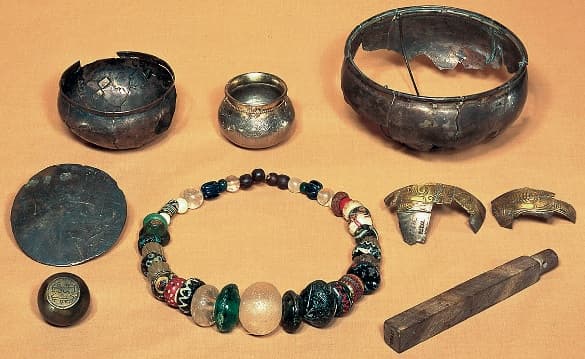
The great feasting hall depicted in the English epic poem Beowulf may be located under a field in east Denmark. Tom Christensen, curator of Denmark’s Roskilde Museum has been leading the archaeological investigation.
Artifacts found in Lejre: silver vessels, a string of beads, a weight, a whetstone, and a disk-shaped silver ingot. (Photo: National Museum, Copenhagen)
Broken dinnerware and some pretty old leftovers figure in our Geo Quiz.
So where did the young Beowulf take on Grendel, the man-eating monster?
"After they fall asleep, Grendel enters the hall and attacks, devouring one of Beowulf's men. Beowulf has been feigning sleep and leaps up to clench Grendel's hand. The two battle until it seems as though the hall might collapse. Beowulf's retainers draw their swords and rush to his aid, but their blades cannot pierce Grendel's skin. Finally, Beowulf tears Grendel's arm from his body at the shoulder and Grendel runs to his home in the marshes to die." (WIKI)
The archeologists say it was in Denmark's earliest royal capital, a few miles west of Copenhagen.
Tom Christensen leads the archaeological team investigating a site in Lejre, Denmark. It's the answer to our Geo Quiz. And it may be the location of the great royal feasting hall that figures in the English epic. Christensen, curator of Denmark's Roskilde Museum, says the site fits the description in "Beowulf."

