PRX is a 501(c)(3) organization recognized by the IRS: #263347402.
Former US envoy to China says both countries need ‘to give a little’ to secure a trade deal
The World’s Host Carolyn Beeler discusses the implications of the 90-minute call this week between the leaders of the US and China with Nicholas Burns, a former US Ambassador to China under the Biden administration.
A computer screen shows images of Chinese President Xi Jinping and US President Donald Trump in Seoul, South Korea, Aug. 26, 2019.
Ahn Young-joon/AP/File photo
US President Donald Trump picked up the phone on Thursday and talked to Chinese Leader Xi Jinping for the first time since taking office in January.
“He invited me to China, and I invited him here. We’ve both accepted,” Trump later said at the Oval Office.
The 90-minute conversation came at an especially fraught time for Washington and Beijing. The two sides have accused one another of violating a 90-day trade truce that both nations had agreed to three weeks ago.
The World’s Host Carolyn Beeler discussed the implications of the call with Nicholas Burns, former US Ambassador to China under former President Joe Biden.
Carolyn Beeler: What do we know about what was said during the phone call?
Amb. Nicholas Burns: I think it’s very positive that President Trump and President Xi Jinping spoke because this tariff war had gotten out of hand and they’ve been unable to resolve it. And at a time like this, it sometimes takes the two leaders to get together to commit to further negotiations to instruct their ministers that there has to be progress. That appears to be what happened today. So, I think in the short term, it’s very positive. They’re not clearly at a deal yet. There has been a truce of sorts. And it’s a very complex set of issues that needs to be worked out.
Right. So, they are at least talking, as you said, they have not cut a new trade deal, of course. President Trump reportedly initiated this call. Why did he make this move now?
Well, that’s what the Chinese said in their report. The Chinese always say that. In my entire experience over three years in China, they always said, “Well, the Americans requested this meeting or this phone call.” They want it to appear that we’re the ones asking for, or maybe blinking first. And that’s not always the case.
So, I think we have to know more about the White House. I’m just trying to defend the US a little bit here. But the important thing is, at 145% and 125% tariffs, you remember the last month, that stopped all trade between the countries. They had a good meeting following that in Geneva between our Treasury Secretary Scott Bessent and the Chinese vice premier, but that agreement seems to have fallen apart.
So, this is not unusual. Trade issues are highly difficult and complex. They take a long time to work out. So, I would expect there to be meetings at the ministerial level quite soon. They have a 90-day deadline that expires at the very beginning of August. It’s hard to know whether they can meet that deadline. And it wouldn’t surprise me at all if they had to have an extension perhaps into autumn, because these are some of the most important issues between the US and China. And so, a lot is riding on this but I do think this is a step forward.
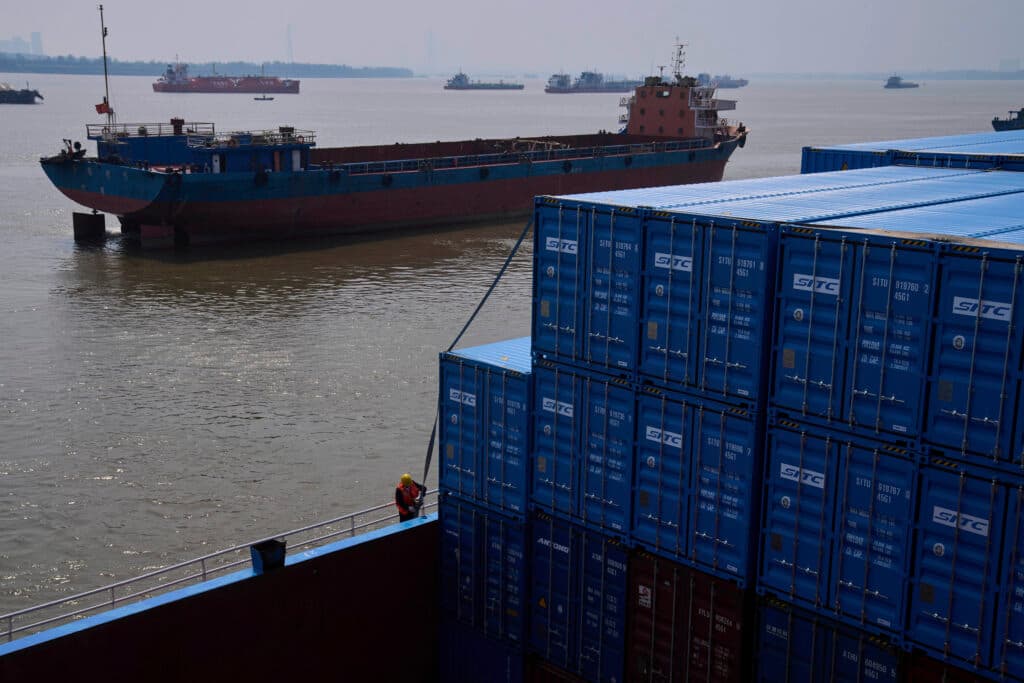
A worker prepares containers for offloading on a cargo ship in Yangluo Port in Wuhan, central China’s Hubei Province, May 23, 2025.Andy Wong/AP
Another key issue here is exports of critical rare earth metals. China recently halted exports of those to the US and US carmakers, and semiconductor producers desperately need them. Can you tell me where this issue stands after the Trump-Xi phone call today?
It’s unclear where it stands. President Trump, I saw, said that it was discussed. You know, this was something that the Chinese did. It was my understanding from the agreement that the two countries had last month, that China would resume the export of rare earth magnets and rare earth materials, themselves, but then didn’t do that and withheld them in order to put pressure on the United States.
Chinese leaders say that Washington had seriously undermined the trade relationship between the US and China by implementing new AI chip export control guidelines and also by calling for the revocation of visas for Chinese students. Are you seeing any signs that Trump may back off of either of those moves?
I guess it’s not surprising the Chinese, this is part of their playbook, also blame the other side for all the problems and take no responsibility themselves. This has been my experience with them, but it’s unfair. It takes two to tango. Both sides have taken some very tough measures over the last month.
I should say that in the Biden administration, we took very tough measure against China because China has not been a fair trading partner for the US for several decades on intellectual property, on forced technology transfer (FTT). So, both sides are going to have to give a little in order to get a deal. That just makes sense in a complex diplomatic negotiation like this.
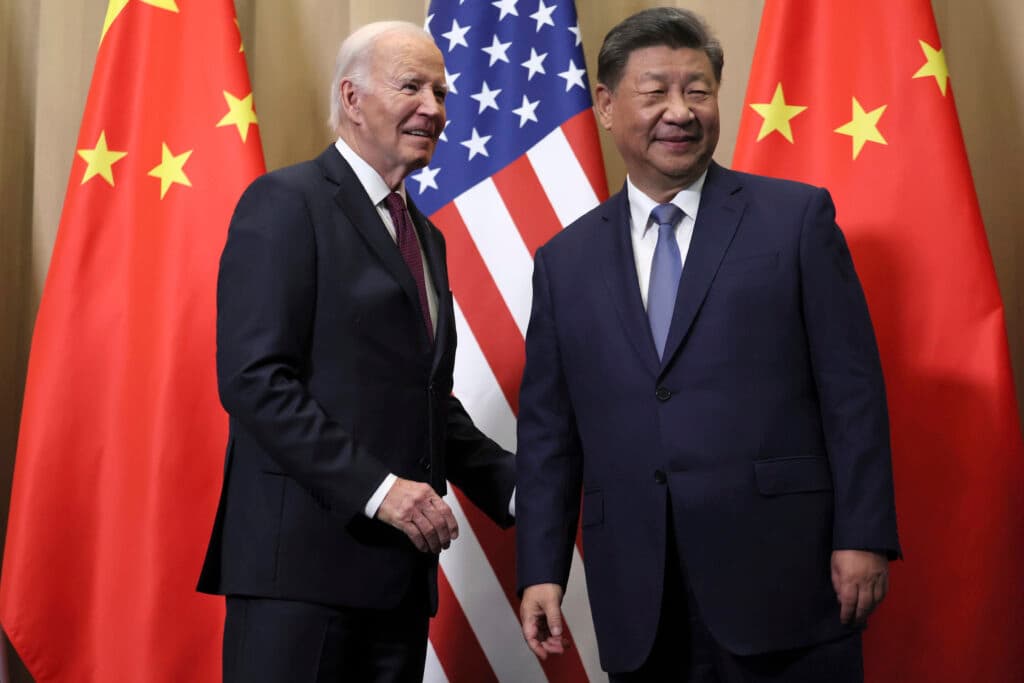
In this file photo, US President Joe Biden and Chinese Leader Xi Jinping stand together before a bilateral meeting in Lima, Peru, Nov. 16, 2024.Leah Millis/Pool via AP/File photo
All right, so both sides are going to have to give a little, you said. President Trump has talked a lot about the problem of the trade deficit. That’s how he introduced these tariffs. What is the administration actually trying to do to close that deficit?
Obviously, we saw what the administration tried to do on Apr. 2, the so-called “Liberation Day.” I think the fundamental mistake that the Trump administration made was that when they put the very onerous tariffs on China, they also put high tariffs on our allies — Japan, South Korea, our partner India, the European Union, Canada, Mexico. All of those countries have the same trade problems with China that we do. It would have been far more effective had we focused on China, placed high tariffs on China — not 145% but high tariffs — and then asked the allies to join us in pressuring the Chinese to cease and desist with some of their more difficult trade measures. I found when I was ambassador that we were always more effective when we worked with our allies against the Chinese.
In the past, whenever top officials from the US and China met, human rights would either be on the agenda or US officials would acknowledge why they were not discussing it directly. That did not seem to be true in this call. I’m wondering if that norm has gone by the wayside.
I certainly think it’s very important to keep human rights issues on the agenda. The People’s Republic of China is a massive violator of the rights of the Uyghur population in Xinjiang province, in Tibet, in Hong Kong. I saw firsthand the repression of Christianity and other religions in China itself. China is one of the worst offenders in the world. And so, I don’t think it is smart, I don’t think it’s right, if suddenly we’re going to take the position in the United States that we’re not going to talk to other countries about their human rights violations.
And when President Trump gave his speech in Riyadh, Saudi Arabia, a couple of weeks ago, that he would not talk about human rights to those countries or other countries and would not lecture countries, well, that’s a real deviation from where nearly all of our presidents — not all, but nearly all of our presidents — have been over the last half century, both Republican and Democrat.
And so, you know, you’ve got to work with China on a variety of issues. And I think today’s phone call was probably appropriately on the one issue of trade, but human rights should be on the agenda, the American agenda, as we talk to the Chinese.
This interview has been lightly edited and condensed for clarity.