China links riots to “terrorist camps”
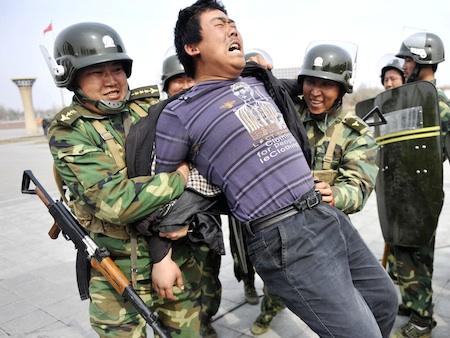
Chinese security forces show off how to quell a riot during a demonstration in Urumqi, China’s farwest Xinjiang region on April 1, 2011. Xinjiang is on the whole safe and stable, but facing severe challenges in maintaining social stability as its social management foundation is still weak, a local officials said recently, following the July 5, 2009 riot in Urumqi which left 197 people dead and more than 1,700 injured.
In rare scenes of chaos in strictly controlled China, explosions and knife attacks left 15 dead in Muslim-majority Xinjiang province. Authorities are continuing to connect the violence to "terrorist camps" in Pakistan.
The latest attacks in Xinjiang province, historically dominated by the Muslim Uighur minority, involve two men hijacking a truck, stabbing the driver and plowing into pedestrians. This follows the torching of a restaurant and four bystanders hacked to death outside.
Is this just rioting by ethnic Uighurs, a group openly frustrated over state-sponsored waves of majority Han Chinese flooding into territory that was once theirs?
It's worse than that, Chinese authorities say. They claim the unrest is instigated by hardliners who have taken explosives and firearms training in Pakistan, according to Reuters.
Chinese officials have increasingly pushed this line as riots and protests have increased in number. So far, the unrest hasn't shown signs of expert coordination. And China is also fairly loose in deeming anyone seeking to protect Uighur identity as an enemy of the state.
Maybe they're just riled by the fast influx of Han Chinese and its effect on the economy, writes Global Post contributor Josh Chin, who compares the violent flare ups to L.A.'s 1992 street riots. PBS also has an excellent explainer column here.
Every day, reporters and producers at The World are hard at work bringing you human-centered news from across the globe. But we can’t do it without you. We need your support to ensure we can continue this work for another year.
Make a gift today, and you’ll help us unlock a matching gift of $67,000!