PRX is a 501(c)(3) organization recognized by the IRS: #263347402.
To rediscover time, go for a walk
National Geographic Explorer Paul Salopek has been walking across continents for his project, the Out of Eden Walk. In that time, his perception of the flow of time has changed drastically from his former sedentary life. He joins Host Marco Werman to explain what he means by that, and shares his discovery of what he calls “walking time.”
At the start of the Out of Eden Walk, in January 2013, Salopek and cargo camels follow guide Ahmed Elema across the Afar region of northeastern Ethiopia.
We have heard a lot about the benefits of walking — not only for our physical health, but also for our minds. It offers a chance to pause, appreciate the pace of life at a human rhythm, breathe deeply, recenter yourself and be present in the moment.
National Geographic Explorer Paul Salopek has, for the most part, managed to do that for the last 13 years and counting while traveling the globe on foot and documenting it all in the Out of Eden Walk project.
“It’s something that I didn’t expect to discover when I set out on this walk,” Salopek said. “You know, walking across continents, horizon to horizon, kind of unlocked elements of time in my mind that I’d never experienced before.”
He shared with The World about what he calls “walking time.”
“There were times when I thought the entire planet under my feet was a giant clockwork. There were days where you kind of get into this mental time zone, where you can almost feel the globe turning under your feet, so that it’s not you that’s really moving, it is the planet that’s kind of creaking like a big gear and a clock. And it’s kind of timeless, these moments of timelessness.”
Marco Werman: So you did not expect walking time. How did it first hit you or occur to you? Or did you realize a shift after it was kind of complete?
Paul Salopek: You know, it came subtly. There were days where time itself seemed to have a different value, a different weight, a different quality. Walking in countryside, which tends to be kind of quieter, you know, your body slides through it with kind of more equanimity, more silence. I could almost feel time slow down, to the point where I started calling it “sacramental time,” Marco, an eternal present. Where the past and the future could occupy the same space between footfalls. There were other times when I was walking along, I don’t know, super busy highways like the Grand Trunk Road in Pakistan, where time itself seemed to speed up. Not just the traffic, but the actual fabric of time started gushing like a whitewater river. So, I started thinking of the topography of time. There were pools of time that were still. There were gushing rivers of time that were fast. And it took slowing down, with millions and millions of footsteps, to finally apprehend it in a tangible way.
So, I want to know how walking time has shifted in the modern world. You were talking about rural areas, time slowing down, big cities, which you’ve encountered many of, are synonymous with hustle and bustle, the opposite of this phenomenon in the countryside. What happens to your sense of time in cities?
I feel like I’m out of sync. Everything speeds up. The sounds speed up, the visuals speed up. I start feeling myself kind of materially getting less and less real. I almost start to end up feeling, for the first day, Marco, like I am a ghost. Have you seen those fast-motion movies where you see lights and traffic going like crazy? That’s what it seems like. And like, I’m the only guy, my walking partners and I are the only people who’re kind of walking and at a real “timeframe.” Everything else is sped up around me like a movie, and it takes about a day or two for that eerie feeling to kind of wear off, and then I kind of get on urban time myself.
And then you also move through small villages in India, which provide a really stark contrast. How would you describe the speed of time there?
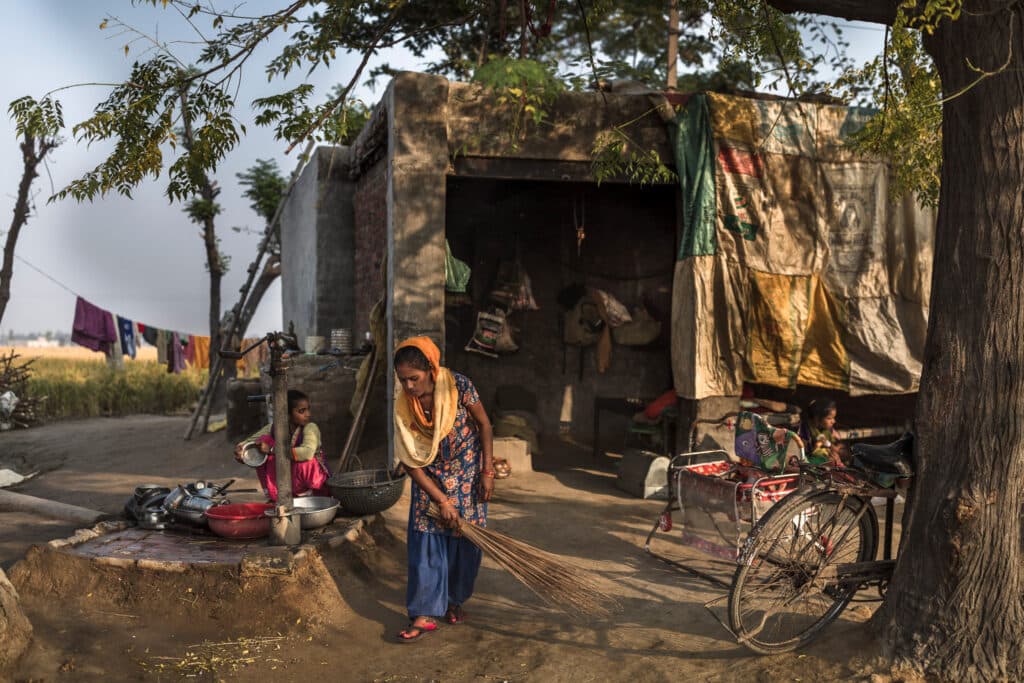
There’s a paradox, because even the countryside, and I’ve walked mainly through northern India, is still quite densely populated. So, in the countryside, there’s a village every two kilometers, which is a little bit over a mile apart. That depends on how fast you walk; that’s 15-20 minutes. This distance is very human. It’s like it’s what takes you to go see a neighbor. Or walk to a shop. The human muscle-shaped landscape also affected the experience of time, because a lot of people are still out walking in rural India. It was one of the places where I actually kind of fit in, because I was not just a crazy walker with a walking partner out by myself; Millions of people are out there walking. There, I felt that the granularity of time, with so much that is attached to kind of handmade things, was very dense. I described it as kind of like a dark star of time, where I kind of, like, every second weighed on me, right? These are psychological effects, these are emotional effects, but I feel like after 13 years, Marco, that I’ve walked through centuries and nanoseconds, and it just depends on where I am on the surface of the earth for these kinds of things to manifest.
It took Salopek 17 months to walk across northern India. Poverty drives many Indians to move around in search of work—these young people from Madhya Pradesh took jobs as farm laborers in Punjab.John Stanmeyer/Out of Eden Walk, National Geographic
So speaking of walking in the modern world, you get to Myanmar in the middle of the 2021 military coup, and you say time for you stopped. Can you explain?
There’s this feeling … Probably you can contribute some of it to adrenaline, probably you can attribute it, at least in my case, to grief, where something terrible happens in front of you, and it’s just like the clock stops and almost your heart stops with it. That’s what I felt by the end of that experience. When I finally had to leave Myanmar, I felt like I’d been arrested in time, and it was a time of great tragedy and an enormous amount of pain. So … I don’t know, I have a friend who’s a great writer, and he says, about writing about things like pain, slow down where it hurts when you’re writing about pain. And I think in Myanmar, it just actually slowed down to a stop. I felt like a part of my life just stopped in Myanmar.
Did it feel like time resumed when you left Myanmar?
Very much so.
You know, Paul, I’ve been struck this week by the Artemis II mission and the poetic takeaway the crew had upon return, as member Christina Cook explained so beautifully, “We should be a united crew on planet Earth,” as they look back at the blue ball against the stark dead blackness of space. You’ve got the privilege of moving at human speed, but at the slow end of things, not 25,000 miles per hour, but at four. What thoughts occur to you because we’re all space travelers, but you’re really a space traveler?
Yeah, it’s kind of the anti-space traveler in a sense, it’s inner space, right? I think what this walk has done for me has, in fact, emphasized the commonality of human time. All the things that kind of have us a little anxious, a little unsettled about speed, about quickness, come from that, come from an acceleration of civilization, right, in the last couple of generations. And I think … The luxury, the gift of being able to slow down to what I would say is quote-unquote normal time, which is the time it takes to walk across a room, a city or a continent, puts everybody kind of on an equal footing, an equal time frame. And eventually, even those zipping cars that go by me, like in that fast-motion film when I walk into big cities, they have to pause sometimes. And I often wish … When they get out of the car, if they could take a break; and even if they’re just walking from their parked car and parking lot to where their apartment is, they rejoin kind of the common bedrock of human time, human experience … which I believe is walking.
Parts of this interview have been lightly edited for length and clarity.
Writer and National Geographic Explorer Paul Salopek has embarked on a 24,000-mile storytelling trek across the world called the “Out of Eden Walk.” The National Geographic Society, committed to illuminating and protecting the wonders of our world, has funded Salopek’s project since 2013. Explore the project here. Follow the journey on X at @PaulSalopek, @outofedenwalk.