PRX is a 501(c)(3) organization recognized by the IRS: #263347402.
‘Dobre Dobre’: A cookbook that highlights Polish and Jewish baking traditions
Host Carolyn Beeler speaks with writer and baker Laurel Kratochvila about her new cookbook, “Dobre Dobre: Baking from Poland and Beyond.” She shares a recipe for Hanna’s apple cake with The World.
The “Dobre Dobre: Baking from Poland and Beyond” cookbook features Hanna’s apple cake, which is a family recipe whose journey spans the whole 20th century.
Courtesy of Malgosia Minta
It is fall, which means it is finally safe to fire up your oven again. Maybe knead some of your feelings into a sturdy bread dough.
For some baking inspiration, The World’s Host Carolyn Beeler spoke with writer and baker Laurel Kratochvila, who just published the cookbook, “Dobre Dobre: Baking from Poland and Beyond.”
Carolyn Beeler: So, you start your book with a quote that I would also like to start this interview with. You write, “I fell in love with Polish baking because I didn’t like the pickles in the Czech Republic.” Please explain.
Laurel Kratochvila: Well, so, what do pickles have to do with Polish baking? Well, about 18 years ago, I found myself living in the Czech Republic, and I was so disappointed to find that the pickles in the Czech Republic are sweet. And I’d been hoping for some real sour pickles. Central, Eastern Europe, this is the land of pickles. And I started dating a guy. I think it was our second date. He said, “Well, if you don’t like the pickles here, let me take you to Poland.”
And it seemed like such a ludicrous idea, but it was really about an hour, hour-and-a-half drive. We get to the other side. We were near this town called Jelenia Góra. First fruit and vegetable stand we saw, we just pulled over and they sell loose pickles. And I was so happy. And then I saw a bakery. And we had to go into the bakery.
And in the bakery, I was so surprised to see just a shelf full of challah. I recognized this. It was like being home, like being in like a good Jewish bakery in New England or New York. And I think that was my first moment of, “Aha, this is the country where I find the food that’s familiar to me, that I love, that touches upon nostalgia” because I really felt at home through that experience.
You wrote that the challah tasted like the challah that you grew up on. You are Jewish, you have Polish heritage. I’m curious why this surprised you, I guess, that this existed in Poland?
What surprised me about it is that it was in a context that was not Jewish, right? So, you would find challah in a Jewish bakery. You could get it in a grocery store, of course. But it is a Jewish bread. And here I was in rural Poland, no Jews in this region for who knows how long. And there’s challah. And I think that is what made it exciting and surprising to me, and just kind of opened a little Pandora’s box that made me want to look more.
You write in the intro to your cookbook that the overlap is so complete between Polish baking and Jewish baking, as you discovered in that bakery, that it is impossible to disentangle the two. Can you explain a bit of the history there?
Sure. Before [World War II], there was a large Jewish population in Poland, and, yet, despite being a minority, Jews were sort of overrepresented in the baking fields. It was a profession that Jews were allowed to do. And you would rarely find a town without a Jewish baker. So, it was a very Jewish profession in Poland. And there was a lot of back-and-forth commerce. This wasn’t a segregated market. Jews were selling to Gentiles and vice versa. That is the history of a bakery there.
So, the challah continued in Poland as a Polish baked good, but some of the foods that Jewish bakers baked disappeared in Poland after the Holocaust when those Jewish bakers were no longer there. The bialy is one example. Can you tell me a bit of the history of that one, and what it is for those who aren’t familiar?
Sure, that’s shorthand for bialystoker kuchen, which is a Yiddish word for “bialy cake,” really. And it’s a salty bread. It’s covered in poppy and onion. And this was a food that was made exclusively in Białystok, and it no longer exists. You know, I walked all over Białystok, and you can’t find it there.
Where you can find it though, and this is something I talk about in the book because there’s really a renaissance happening right now of contemporary bakeries that both take inspiration from the farm-to-oven baking movement, so using good grains, but also looking into history.
And one baker who I know, her name’s Monika Walecka. She has a wonderful place in Warsaw. And I think she’s one of the first people I know to really bring back the bialy to Poland. And she does these wonderful ones, sourdough with potatoes and nigella as a kind of modernization of the traditional onion and poppy seed.
And of course, [bialys] have also long existed in “exile,” I think is the word you used, in New York and New Jersey.
Yes, of course.
So, I think it’s high time that we s talk some recipes. Hanna’s apple cake. Can you tell me the story behind that recipe?
So, first of all, there are 10 recipes in the book that are contributed from other bakers, both in Poland and of Polish or Polish-Jewish origin around the world. And Hanna’s one of them. She’s based in London. But this is her grandmother’s apple cake. And it started in Lublin. That’s where her grandmother was born.
It was a family recipe and spans the whole 20th century. Because first they left Lublin as economic migrants to Vienna. And then Kristallnacht happened and they moved to, I believe it was Paris, and then Casablanca. And then all the way to South America, they were in Montevideo. They moved to Texas. And finally, we’re talking three generations later, Hanna lives in London, and her grandmother passed down this recipe for her when she was hosting her first Rosh Hashanah.
It’s this wonderfully, kind of dense, very moist in the middle, very sugary, crusty, crunchy on the outside, it’s a unique texture. But it’s such a good example of the diasporic nature of Polish baking and how it’s moved around the world, and changed a little as it’s gone. So, her grandmother would have just used regular oil in this. Whereas, Hanna changed it up a little, modernized it a bit, and she uses olive oil and brown sugar. And it just gives it this little extra something. Yet at its essence, it’s the recipe from Lublin.
See below for the recipe for Hanna’s apple cake.
Yeah, other recipes in your book have stories like this one, recipes being passed down, crossing borders, being tweaked. I’m wondering if there are, kind of the fingerprints of that movement in any of the other recipes, ingredient changes, things like that?
Yeah, absolutely. I played around with a few recipes. I have very updated bialy, with a horseradish cream and spring vegetables. And then also, there is a chef in Melbourne who works in the fine dining world. His name is Zackary Leon Furst. And what he likes to do is take like a classical Polish recipe, that’s very often things that his grandparents made, and adapt it for that fine dining environment. So, he has this very elegant honey cake with a raisin jam and a honey cream that we have in the book. So, that’s an example of the changes and the adaptations that recipes are taking on these days.
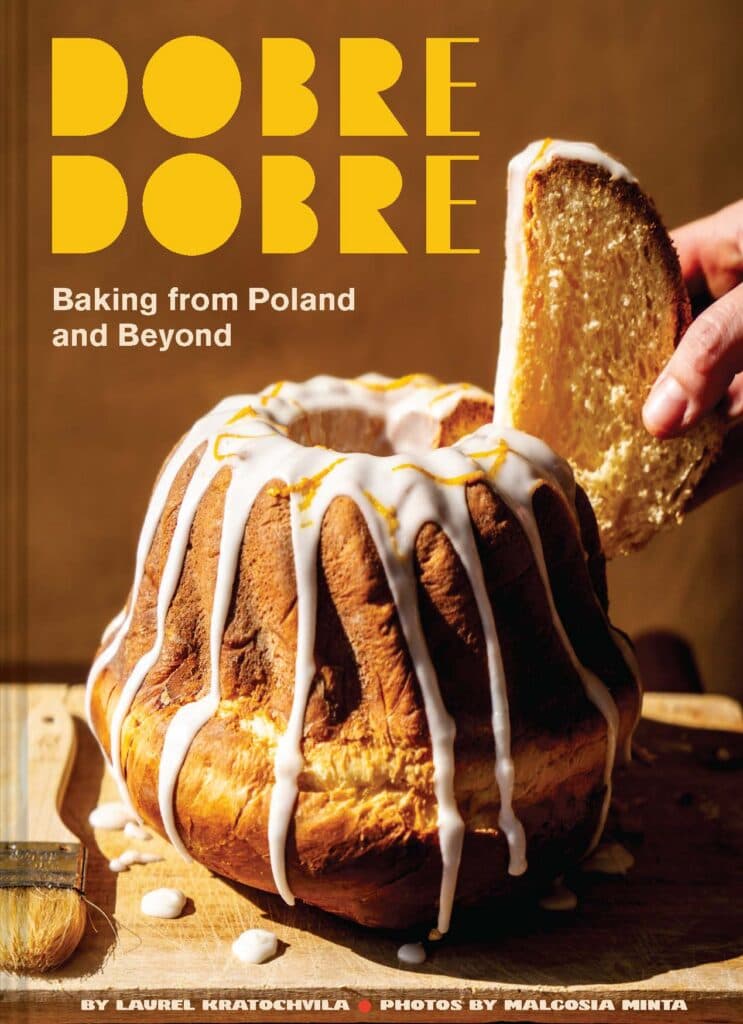
Before I let you go, I did want to ask about the title of your cookbook, “Dobre Dobre.” What does that mean and why choose that as the title?
So, dobre dobre means “good good” but the full phrase is dobre dobre nie za słodkie, which means “good good, not too sweet.” And this is a Polish complement for a cake or a pastry. And I love it because it’s a little counterintuitive to the American way of thinking, which is “we want our desserts as sweet as possible.” And a lot of Polish desserts, it’s about letting a seasonal fruit shine or getting a bit of a sweet crunch from streusel. And so, it’s a bit of a different philosophy around baking. And I love that.
This interview has been lightly edited and condensed for clarity.
The cover of the “Dobre Dobre: Baking from Poland and Beyond” cookbook.Courtesy of Malgosia Minta
Hanna’s Apple Cake Recipe
Makes one 9-inch cake
Ingredients: 14 oz [400 g] cored and peeled firm apples (4 to 5, such as Braeburn or Royal Gala) 1 Tbsp [15 g] lemon juice 1 cup [220 g] olive oil 1¼ cups [250 g] caster sugar ¼ cup [50 g] soft brown sugar 3 eggs 1 tsp vanilla extract 2½ cups [300 g] all-purpose flour 1 tsp baking soda ½ tsp double-acting baking powder 1½ tsp ground cinnamon ½ tsp kosher salt Demerara sugar, for sprinkling
Directions: Preheat the oven to 340ºF [175ºC]. Grease a 9 in [23 cm] springform pan or angel food cake pan and line the bottom with parchment paper.
Peel, core, and thinly slice the apples. Place in a medium mixing bowl and toss with the lemon juice (the acid in the lemon juice will prevent browning).
In the bowl of your stand mixer fitted with the paddle attachment, combine the olive oil, caster sugar, brown sugar, eggs and vanilla and beat for 3 to 5 minutes, until thick and completely emulsified. Meanwhile, in a medium bowl, combine the flour, baking soda, baking powder, cinnamon and salt and stir together. In your stand mixer, continuing to mix on low speed, add the dry mixture to the wet mixture until just mixed with no dry bits. (You can also do this part by hand with a rubber spatula to ensure you don’t over-mix.)
Once the batter is combined and thick and no dry pockets of flour remain, assemble your cake, pouring batter and layering apples in stages. Place half of the batter in the bottom of your pan, then cover with half of the apple slices. Cover this with the second half of the batter, then arrange the second half of the apple slices over the top in a pretty spiral. Sprinkle the top with demerara sugar and bake for 70 to 75 minutes, until the cake is firm to the touch and a tester comes out clean. Cool completely before sliding a butter knife around the edge of the springform pan, then releasing it and slicing.
This cake is best the second day and can last up to five days at room temperature sealed airtight.