Wall Street rallies after European pledge
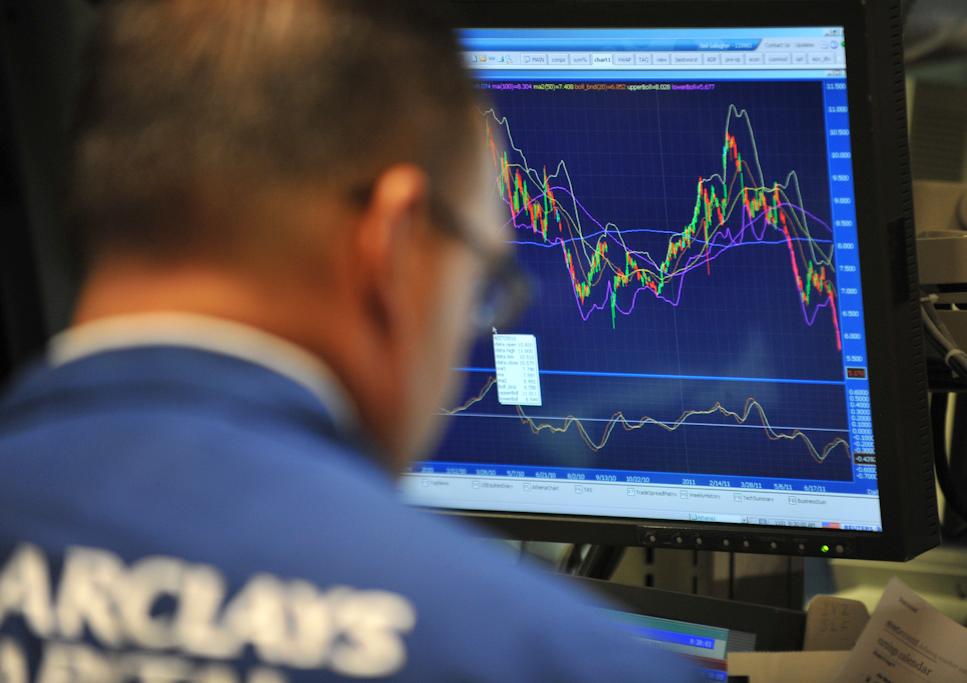
A stock specialist watches prices as he works on the floor of the New York Stock Exchange August 5, 2011. The Dow Jones Industrial Average climbed 0.2 percent to 11,403.06 in early trading on Friday, in a volatile opening after the release of a better-than-expected US employment report. The broader S&P 500 was down 0.1 percent to 1,199.00, while the tech-heavy Nasdaq Composite slumped 0.7 percent to 2,538.53 after 40 minutes of trading. Stocks initially rallied more than one percent, then pared their gains and dipped into the red after the US Labor Department said the country’s economy generated 117,000 jobs in July, cutting the unemployment rate down a notch to 9.1 percent.
U.S. stocks rallied Monday morning as French and German leaders pledged to address the debt crisis hitting Europe, Bloomberg reports.
Not only did U.S. stocks soar, the Euro surged the most since July 2010 against the dollar, with the Stoxx Europe 600 Index jumping 1.5 percent and the Standard & Poor’s 500 Index seeing an increase of 2.8 precent, Bloomberg reports.
The S&P 500 topped a key technical level for the first time in more than two months in what could be a bullish signal, Reuters reports.
More from GlobalPost: Global economy: Is 2011 worse than 2008?
U.S. and global stocks rallied as the markets opened Monday morning in response to German Chancellor Angela Merkel and French President Nicolas Sarkozy promising to deliver a plan that will address the Greek debt crisis by the Nov. 3 Group of 20 summit.
Merkel and Sarkozy said they will present a plan to recapitalize European banks, targeting the debit crisis. This alone lifted the hopes of American and European investors.
France and Belgium’s plan to nationalize Dexia, the Franco-Belgian bank, also sparked the sentiment that governments will prevent large lenders from going under, the Economic Times reports.
More from GlobalPost: Bailout of Dexia bank amid fears of a deepening debt crisis
Just last week U.S. stock indexes roses three days in a row after nearly falling into a bear market. These gains may be an indicator that the U.S. economy is in better shape than analysts expected, the Los Angeles Times reports.
More from GlobalPost: Global economy: 10 signs we're in trouble
The article you just read is free because dedicated readers and listeners like you chose to support our nonprofit newsroom. Our team works tirelessly to ensure you hear the latest in international, human-centered reporting every weekday. But our work would not be possible without you. We need your help.
Make a gift today to help us reach our $25,000 goal and keep The World going strong. Every gift will get us one step closer.