Public radio’s longest-running daily global news program.
©2026 The World from PRX
PRX is a 501(c)(3) organization recognized by the IRS: #263347402.
Q&A: When you ask a leading architect to predict the future, this is what it looks like.
Hashim Sarkis thinks the world’s becoming one giant urban landscape.
CAMBRIDGE, Mass. — Hashim Sarkis’ office overlooks some of the most impressive rooftops of Harvard Yard: the iconic Harvard Lampoon building; the newly-renovated Harvard Art Museums, designed by virtuoso architect Renzo Piano and opening this week. In the distance you can see the corners of the Carpenter Center, a work by the pioneering modernist Le Corbusier.
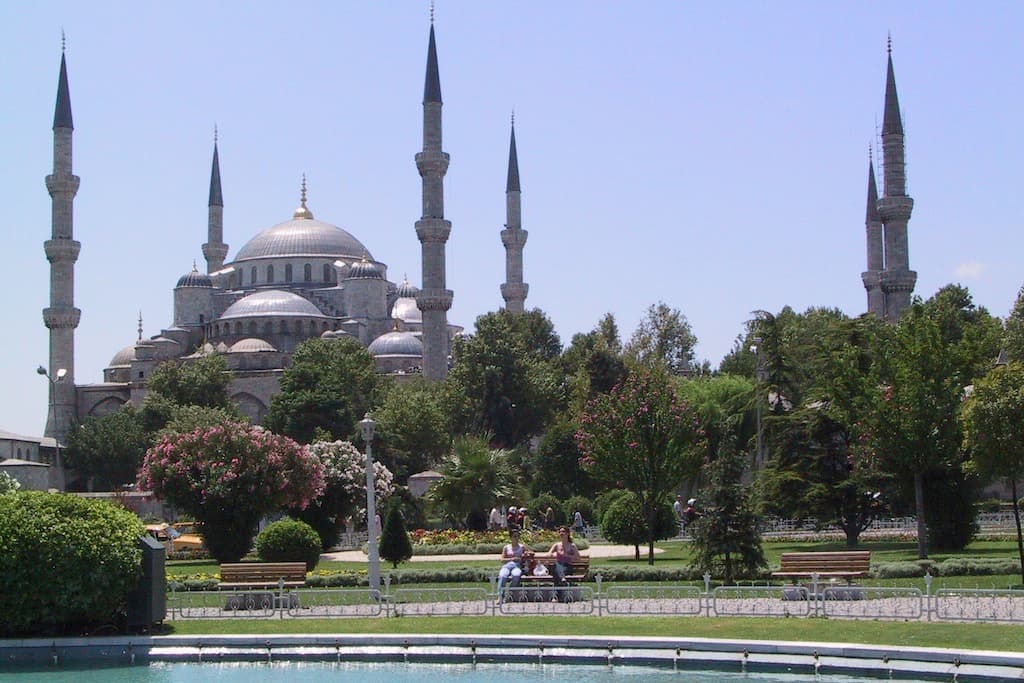
It’s a gorgeous view, and not hard to compare with some of the world’s most famous urban landscapes, from Florence to Montreal to Istanbul.
But Sarkis, a prominent scholar of architecture and urbanism, wants to look at it differently.
“If the urban is about diversity, how can we keep talking about ‘the city’ in the singular? Maybe there's another way we can talk about it,” he says when I ask him what the modern city will look like. “Perhaps we can … analyze more carefully the different things that we call 'city.'”
Sarkis is the newly appointed dean of MIT’s School of Architecture and Planning and has spent a decade at Harvard University’s Graduate School of Design, where he is currently the Aga Khan Professor of Landscape Architecture and Urbanism in Muslim Societies. He’s also still a practicing architect, whose work spans the United States, Canada and the Middle East. His work has been displayed at the Museum of Modern Art in New York and at Biennale exhibitions in Venice, Rotterdam, Shenzhen and Hong Kong.
After a long career studying urban societies and how they function, Sarkis believes we’re beyond thinking about so-called world cities like Tokyo, London and New York as being the main places where ideas and culture cross borders.
The world is in effect becoming one city, Sarkis contends, connected by virtual realities if not physical ones. This concept has been introduced in science fiction, as was the term ecumenopolis, introduced in 1967 by the Greek city planner Constantinos Dioxiadis, who believed that urbanization and population growth would in time lead to a world where major cities have fused into a single entity.
For Sarkis, it has become unproductive to say a person lives “here” or “there.”
“Maybe we can come up with a much broader list of categories rather than talk about 'urban' versus 'rural,' and consider a broader range of possible ways of living together,” he says. In fact, he concludes, “this is precisely what the city is about.”
I sat down with Sarkis to learn more about his ideas and what they might mean for the world's urban future. This is an excerpt of that interview.
How do you envision the concept of “the city” as the world merges cultures?
The city as an entity has become difficult to understand or explain because it's everywhere and nowhere. It's scale-less. It's no longer bounded. Somehow old classifications have become unproductive.
It turns out people have been talking about this since the late 19th century in science fiction. It's interesting that in H.G. Wells’ “War of the Worlds,” what unified the world was the war. … I feel that there's a lot of work to be done on the question of where the city is going.
Where are we now?
We now live in an urban age. The United Nations reports that more than 50 percent of the world [population] is in cities, which is quite problematic because it excludes another fifty percent who are actually as connected with the use of Internet and accessibility of flight. Using the term “city” misses the fact that you can be in the most remote town outside of Edmonton, Canada and still be very connected. You’re still living an urban life.
I don't think defining what is urban is clear anymore. What makes a “world city?” London, New York, Tokyo — these are the hubs of the global economy and they are the concentration of everything, but I also feel that we need to talk about the actual world as a city, meaning not “world cities” but a “one-world city.”
Would you give us an example?
Paris is so homogeneous and continuous and regular compared to London. London is a cluster of villages next to each other, right? We can ask which places are much more spread out? We can ask which places are tighter? That gives us a bigger repertoire than “city/not city” because it actually reflects more accurately how we're living today. Rather than answer the question directly, we begin to see it from another angle that helps us move forward as architects and as a society.
As a scholar and architect working in the US and abroad, what knowledge and Western practices do you take back to the Middle East?
When I started my practice in the late '90s in Beirut, I would say I took something back. But now I don't see it like that anymore. My life is no longer “here” or “there.” It's in both places simultaneously. It has converged in many ways and it is not until I am in Beirut and stuck in traffic that I realize it's a different world.
The idea of the here and there is one of the things I question and maybe I'd not have questioned it had I been only there, or had I only been here. For me, it is one world and I always yearn in my work to express it as such. These differences from which we form our identities are too small for them to matter. I seek more common human values as things that bind, and that's what I'm looking for in architecture.
One of the three books I'm working on is called “Beirut: Normal” that is trying to answer these questions. Is there anything we can say about Beirut that is normal and not exceptional or traumatic or violent? Can we see this confluence of East and West or Muslim and Christian? I don't think there's a big difference between them. There are big differences between the poor and the rich and the way the poor live in the Muslim communities is close to the way the poor live in the Christian communities. I think the class differences are far more significant than the ethnic differences.
An extended version of this interview was originally published on TheEditorial.com. It has been excerpted here with permission from Heidi Legg.