PRX is a 501(c)(3) organization recognized by the IRS: #263347402.
AI may be messing with our memories
A casual conversation with a friend led NYU neuroscientist Tim Requarth down an unsettling line of inquiry. His friend had made an AI video of himself scaling Mt. Rushmore, and a little while later, he felt the slightest bit of a memory of being at Mt. Rushmore — even though he had never been there. The World’s Host Carolyn Beeler speaks with Requarth about why our brains’ process for making memories seems to be vulnerable to generative AI.
It was a casual conversation with a friend that got Tim Requarth a bit freaked out. The friend had made an AI video, a fake video of himself scaling Mount Rushmore. And then some time passed, and the friend felt a tug of memory, not of making the video, but of actually scaling the mountain.
As a neuroscientist, Requarth had questions about the effect of AI on our brains, which he explored for an article in Longreads.
“The brain has some very fundamental processes for sorting reality from fantasy,” Requarth told The World, “… and it surprised me that something as simple as an app could trip those up.”
Carolyn Beeler: To begin to understand this a bit more, I want to have you walk us through how our brains actually store and retrieve memories. You wrote, hopefully, I think, that it doesn’t work like your phone storing photos. It’s actually more like your brain partially reliving the event. Tell us how that works.
Tim Requarth: Yeah, so memory is a little bit different than phone storage, where you have a photo and you can go look it up. And if you’re not looking at it, it remains the same. And when you pull it up, it’s the same every time. In memory, what’s interesting is it’s a replay, not a retrieval. And so, with each replay, it can be a little bit different. So, memory is inherently a little bit unreliable, which I think is something we would all recognize from our day-to-day experience.
Connect the dots for us here. How does that attribute to how our brain’s memory works … how does that make it vulnerable to being confused about whether something you made yourself do in an AI video actually happened or not?
Right. It’s really interesting. And I’ll be honest, I was surprised to hear this. … Let’s say you make a lot of these videos of yourself doing things like, you know, I had my friend who climbed Mount Rushmore, people make videos of themselves dancing in K-pop. People would make more mundane videos of them having a conversation with somebody about just a topic that they were interested in. So, there could be any number of ways. And imagine that you’re doing this hundreds of times. The memory of actually creating that video starts to fade. And the video itself starts to get recalled, but it gets kind of confused with whether you did it or not. And the more realistic or plausible it was, the more likely you’re going to mislabel it as something, not that I did with an AI app, but something that I did personally.
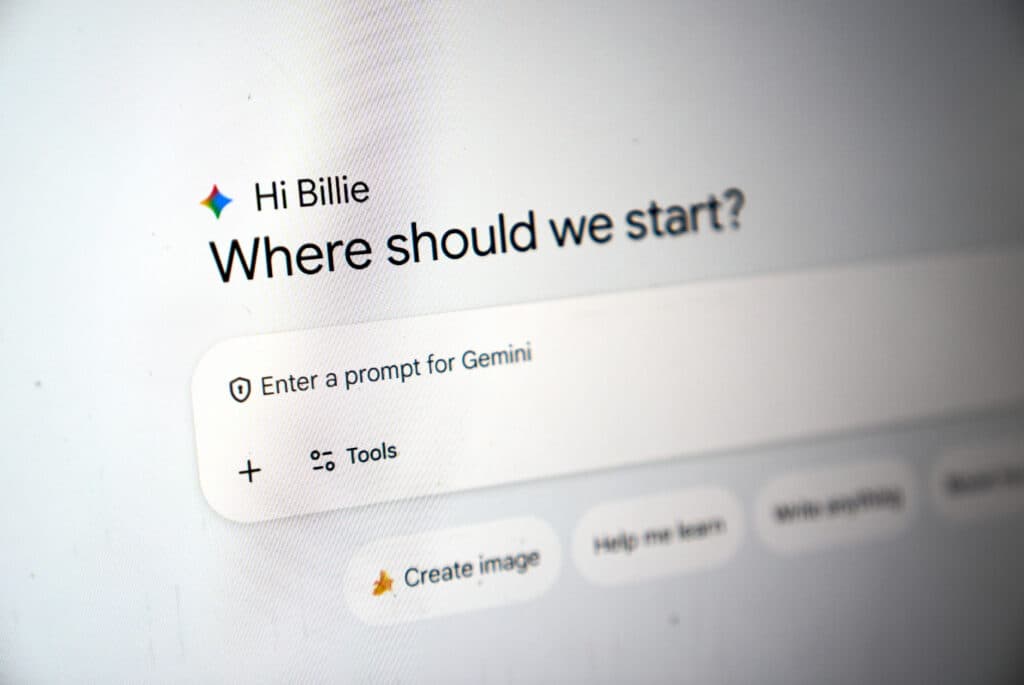
Art teacher Joyce Hatzidakis uses the AI tool Google Gemini in her high school classroom, Jan. 22, 2026, Riverside, Calif.Damian Dovarganes/AP/File
And so because you only make the video once, but you might watch it over and over and over again, those are the sort of neural circuits that keep being reinforced and triggered that start to tell you this is actually a memory.
Yeah, and because it’s video, it’s something vivid when it comes up in your mind’s eye. And it says, “It’s vivid, so it’s probably more likely to be real.”
But does this also happen with, for example, virtual reality, which is very realistic these days, or like first-person video or computer games? Is this the same phenomenon that has already happened with other technologies just kind of tweaked here with AI?
Yeah, I think that’s a great question. I mean, somebody can look at a photograph over and over again, and eventually it can insinuate itself into your memory. So this is not in any way about AI only. The difference is that AI can be very realistic and it can be infinitely generated and watched, and it’s pervading our lives in a way that is different than previous generations of media.
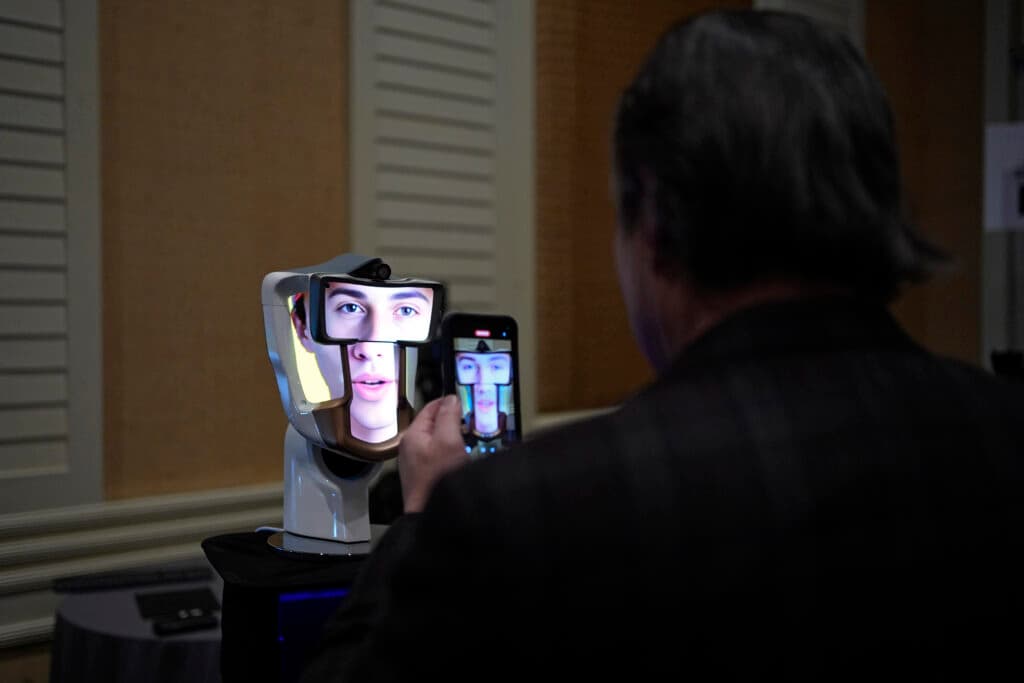
A person takes video of a Wehead interactive AI interface at the Wehead booth at Pepcom ahead of the CES tech show, Jan. 8, 2024, in Las Vegas. The device allows for human-to-AI interaction.John Locher/AP/File
You write about this whole phenomenon with, I would say, concern. There’s some trepidation in your voice in that article. Why?
I find it concerning when a technology can trip up what I call root processes or very fundamental processes in the brain. And so, for example, we’ve already seen with social media that it encourages people to make comparisons of themselves to other people, influencers that maybe are projecting an unrealistic ideal of beauty, intelligence or success and it makes people feel bad. Now, imagine what you can do when you’re seeing images of yourself not quite living up to this reality. So, I think there’s a big potential for this kind of technology to drive or turbocharge some of the dynamics that we’re seeing in social media and take them to the next level.
So, you’re saying you could create, kind of, an idealized version of yourself with AI, and then you would be comparing yourself to this perfect version of yourself and falling short.
You could or a company could, potentially.
Do you think that is more worrisome than comparing ourselves to others?
I think, potentially, yes because I think that it can become internalized in a sense of identity of who we are, where when we really look at a real picture or our real actions in the real world, and they’re not living up to something that has been implanted, essentially, it’ll be hard to be yourself. It’ll be hard to break out of that.
Even if it’s labeled as AI, and you know it is, it still worms its way in there.
Yeah, and that’s a great point. A lot of these things happen a little bit unconsciously and you have to reject them later in your brain and that doesn’t always happen, especially for younger and potentially more vulnerable users.
There’s also something that feels more fundamental about this, because in many ways we are just a collection of our memories. So, what’s really interesting to me here is what you’re suggesting about how malleable our memories are and even our sense of self.
You’re right. That’s who we are. We are the collection of our memories, and we narrativize those to generate a sense of identity. And if that sense is contaminated, it’s gonna contaminate our sense of who we are and maybe what we can be. Is that gonna be neutral, positive or negative? I’m not sure, but the technology is capable of that. And you know, it remains to be seen what will happen with the next generation of self deep fake technology.
Parts of this interview have been lightly edited for length and clarity.