PRX is a 501(c)(3) organization recognized by the IRS: #263347402.
In Nova Scotia, a town protects its history from the sea with living shorelines
In Mahone Bay, Nova Scotia, a nonprofit is expanding a living shoreline designed to protect the community and its historic buildings from climate-fueled storms. The project utilizes rocks, newly planted wetlands and berms to dissipate wave energy before it reaches the shore. The World’s Host Carolyn Beeler spoke with Brooke Nodding of the group Coastal Action to learn more about this climate solution for the series The Big Fix.
Living shoreline in Mahone Bay, Nova Scotia, protecting historic three churches in July, 2025.
Courtesy of Brooke Nodding/Coastal Action
Mahone Bay, Nova Scotia, in Canada, is known for its historic architecture. The most famous are its three churches, standing side-by-side right on the water’s edge.
The churches, and the areas around them, are vulnerable to storms and flooding, which are now worsening due to climate change. To protect itself, the town built a new line of defense: a “living shoreline.”
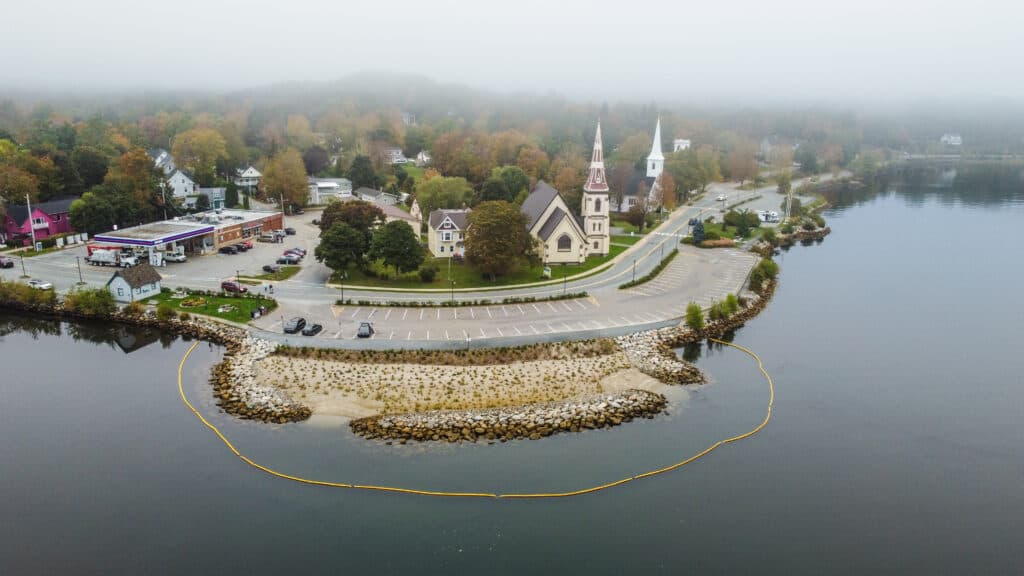
“We have rock sills that are embedded in the soil in the harbor, which follows into a vegetated wetland,” said Brooke Nodding, executive director of the nonprofit Coastal Action, which developed the project.
“That’s followed by a gradually sloped bank, which is also planted with hardy, salt-tolerant and deep-rooted species that help stabilize the bank. And that’s followed by, on the land side, an elevated berm [that will run along the three churches].”
Nodding spoke with The World’s Host Carolyn Beeler about the living shoreline and the current work to expand its length.
Carolyn Beeler: Tell me more about how this living shoreline works when, say, a big storm reaches the area.
Brooke Nodding: The living shoreline, really what it does is it’s lessening the energy of the waves before it reaches shore, and the elevated berm is helping to hopefully reduce the amount of flooding that takes place. So really, it’s not meant to completely stop the impacts of a storm, but it’s meant to reduce and alleviate impacts that we’ve experienced in the past.
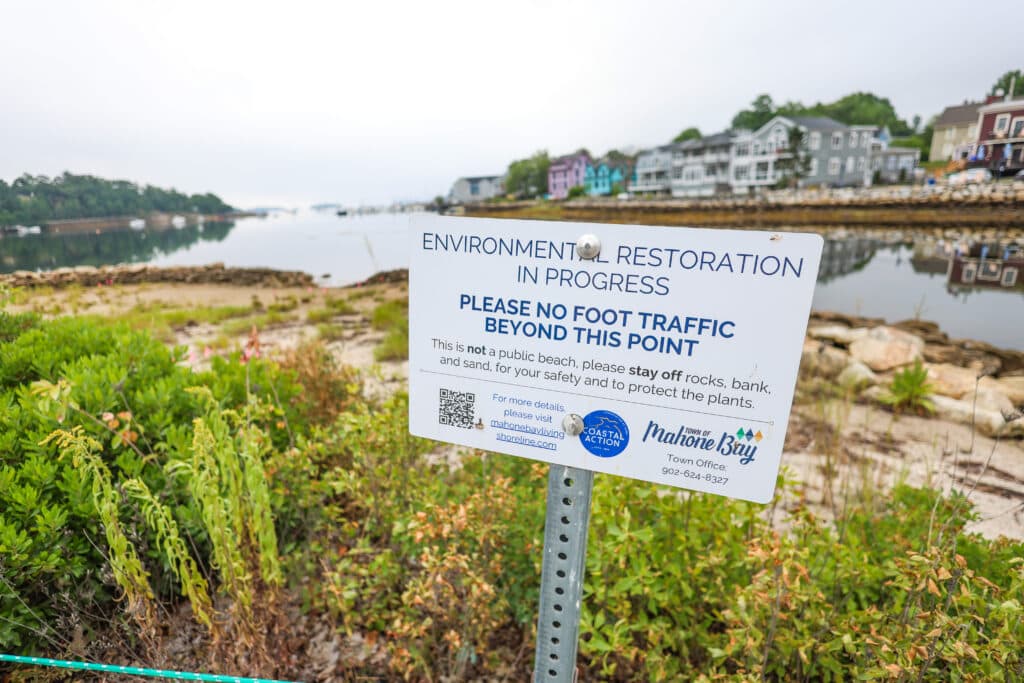
Sign at living shoreline in Mahone Bay, Nova Scotia.Courtesy of Brooke Nodding/Coastal Action
I understand that initially in Mahone Bay there was some resistance to this project. What were people’s concerns?
I think when we first started, some people may have been misinformed or not understanding exactly what the project entailed. People saw us putting material into the harbor and thought it was an infill and maybe just creating more parking or more hard surfaces or that sort of thing.
But I think once the pilot was in place and people were able to see the different components and learn more about them, and [when it] withstood [Hurricane Fiona in 2023], they were able to see and understand what actually was taking place there.
Mahone Bay was not hit as hard as other parts of the Atlantic region by Hurricane Fiona, but we still had received high winds. We still had those high waves and storm surge and that sort of thing. But a lot of [the shoreline] withstood the storm quite nicely.
How much does this kind of approach cost versus what you’re calling harder infrastructure, like a seawall?
It could be a bit more expensive at just initial installation, but I think where the savings comes in is that you don’t really have to reinstall it every time. Once the plants develop and take over and get well rooted, the maintenance on them will be very minimal, if at all.
View of living shoreline near three churches after construction in 2022.Courtesy of Brooke Nodding/Coastal Action
Can living shorelines be created kind of on any coastline or does it have to be a particular type of ecosystem or shore type?
I think every living shoreline, the design and the purpose for each could be different for each specific location. So, even within our kind of 700-meter (nearly 2,300 feet) stretch of shoreline along Mahone Bay, we’re changing our design slightly to accommodate the existing conditions and what we’re able to do. Going further along, we don’t have the room and the underlying soils can’t withstand the weight of of the rock sills. So, there’s going to be various different solutions in terms of level of slope and plants in those areas.
Is there a limit to the intensity of a storm that these living shorelines could protect against? And do you have a sense of how long this type of infrastructure will help as storms get more intense?
I don’t think that we know that right [now], because a lot of these living shorelines are new to our area. I mean, our pilot was kind of the first for Atlantic Canada. We’ll have more information, be more able to answer those questions in the coming years as we continue to monitor the work that we’re doing in Mahone Bay.
I don’t think that we know that right [now], because a lot of these living shorelines are new to our area. I mean, our pilot was kind of the first for Atlantic Canada. We’ll have more information, be more able to answer those questions in the coming years as we continue to monitor the work that we’re doing in Mahone Bay.