Public radio’s longest-running daily global news program.
©2026 The World from PRX
PRX is a 501(c)(3) organization recognized by the IRS: #263347402.

Global EV sales are on the rise. But the end of the internal combustion engine is still far away. For cars, it could take decades. For airplanes, even longer, if it ever happens at all. In the meantime, a team of scientists in Switzerland thinks it has developed an alternative, harnessing power from the sun to create a drop-in-ready alternative to traditional fossil fuels.
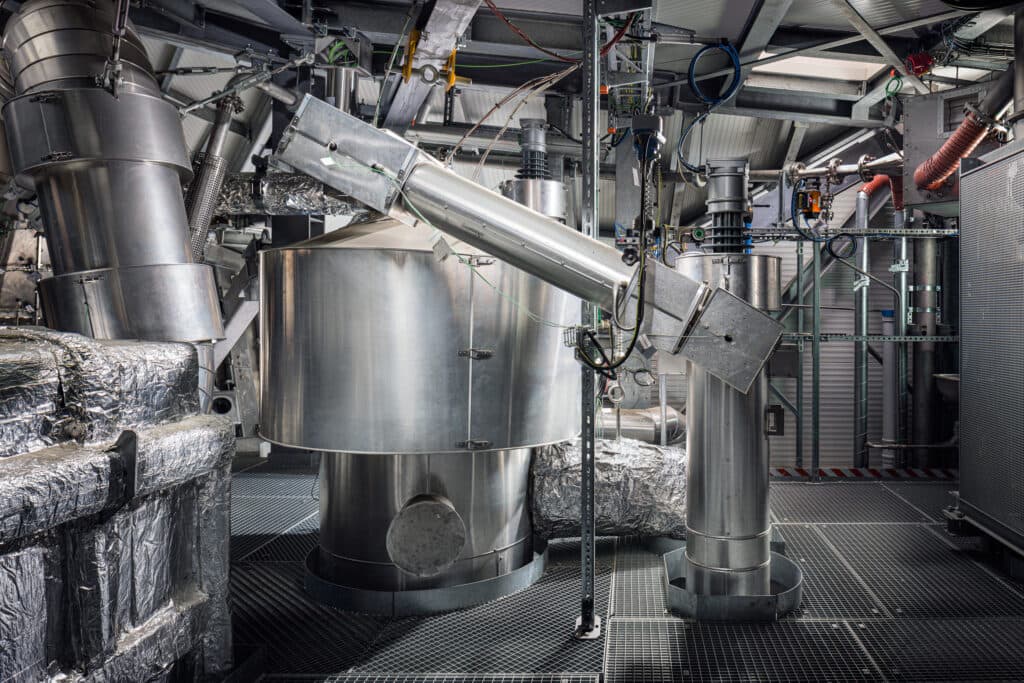
Synhelion’s industrial-scale demonstration plant DAWN for the production of solar fuels.
The YouTube page of Synhelion has a series of videos that look kind of like a combination of a “Fast and Furious” movie and a Silicon Valley tech ad: cars, boats and motorcycles fueling up and going fast.
In the age of electric vehicles, it looks like something from another era. In fact, watching these videos without sound, one might not even realize that they’re advertising renewable energy.
Synhelion is a Swiss startup that produces so-called “solar fuel,” which is a bit of a misnomer, according to the company’s founder and CEO, Dr. Phillipp Furler. The product isn’t actually sunlight in a tank but a synthetic gas made by combining carbon dioxide and water at super high temperatures generated by solar power. Now, it’s being explored for use as a drop-in-ready alternative to traditional fossil fuels.

“We use solar heat to drive a thermochemical process,” Furler said. “Typically, we go to around 1,200 degrees (2,192 degrees Fahrenheit), and we operate the chemistry at around 900 degrees celsius (1,652 degrees Fahrenheit).”
Furler said the company uses a field of mirrors to harness power from the sun. That power is then transferred to a lab, where a thermochemical process is used to create the synthetic fuel, which can be used in the same way as traditional fossil fuels, such as gasoline, diesel and jet fuel. Analysts say it’s an attractive option, because you don’t need to reinvent the wheel and build a new, zero-emission vehicle; you just need to plop in a different kind of gas at the pump.

“[It’s] not just a future hope. [It’s] a present solution,” said Camille Mutrelle, an aviation policy expert for Transport and Environment, a Brussels-based organization that advocates for clean energy transportation.
According to Mutrelle, synthetic fuels like Synhelion’s could play an essential role in decarbonizing the aviation sector, especially on long-haul flights. That’s because, unlike with cars, batteries for airplanes — especially those travelling far — can’t store enough energy. If they were big enough to do that, they’d be too heavy to fly.

“Unlike for short routes, where battery or hydrogen-powered planes might eventually be a viable solution, long-distance aviation simply cannot wait for those technologies to mature,” she said.
Some governing bodies like the EU have set ambitious targets to reduce emissions by incorporating alternatives to traditional jet fuel, including solar, but Mutrelle says that’s not enough.
“You also need to drive the costs of sustainable aviation fuel down,” she explained. “And that requires subsidies.”
Solar fuel is expensive, several times more per gallon than fossil fuel, because, unlike with petroleum, the infrastructure doesn’t exist yet. So, even though it’s drop-in ready, solar fuel isn’t yet a viable commercial alternative. Mutrelle said companies like Synhellion need support in order to scale up and make it cheaper.
“These fuels exist, and now the ball is definitely in the court of governments and whether they can provide the right support for these fuels to take off,” she said.
Synhelion, for its part, isn’t waiting around. Over the past few months the company has been testing its fuel on all sorts of vehicles — and of course, posting flashy videos of their tests online.

“So far, we powered a motorcycle, we powered a steamboat and we powered a historic race car,” said Synhelion’s Furler.
Notably absent from that list: an airplane. But fasten your seatbelts, because Furler said more tests are on the way.
