Australia’s High Court blocks refugee swap deal
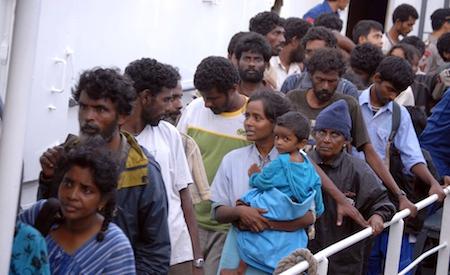
A group of 87 asylum seekers from Sri Lanka are rescued by Indonesian Maritime Police in Panaitan island where they were stranded after they ran out of fuel, food and water. The refugees left Sri Lanka on August 2010 in an attempt to reach Australia’s remote Christmas island.
Australia's highest court ruled on Wednesday that the government's plan to send asylum seekers to Malaysia is illegal.
Under the deal, Australia would have sent 800 asylum seekers to Malaysia in exchange for taking in 4,000 refugees over a period of four years.
The Associated Press reports that the High Court reached a 6-1 majority to make permanent an injunction that has prevented the deal from going ahead.
In a decision that cannot be appealed, the court found that Malaysian law did not offer adequate enough protection for refugees.
Malaysia is not a signatory to the U.N. Convention on Refugees.
Sydney Morning Herald journalist David Marr said the ruling was a "devastating blow" to Australia's ruling Labor Party, adding that the deal had been an "extraordinarily venturesome idea."
(Read more on GlobalPost: Australia attempts scaring off boat people with YouTube)
Immigration Minister Chris Bowen described the ruling as “profoundly disappointing” and an impediment to efforts in tackling people smuggling.
More than 6,200 asylum seekers arrived in Australia by boat in 2010. Most were from Afghanistan, Sri Lanka, Iran and Iraq, and used Malaysia or Indonesia as their departure point by sea.
Sonia Caton, an immigration lawyer, and a board member of the Refugee Council of Australia, told Australia's ABC radio that the asylum seeker plan was “as good as dead”.
I believe there's no lawful basis on which one asylum seeker can be now transferred to Malaysia.
The Australian government had earlier said the deal — which is known in Australia as the “Malaysia solution” and was formed in consultation with the U.N. refugee agency — would withstand any legal challenge.
The ruling was reportedly met with applause in the courtroom, and has been praised by rights groups.
Every day, reporters and producers at The World are hard at work bringing you human-centered news from across the globe. But we can’t do it without you. We need your support to ensure we can continue this work for another year.
Make a gift today, and you’ll help us unlock a matching gift of $67,000!