Germany should stop US corps from giving data to NSA: Report
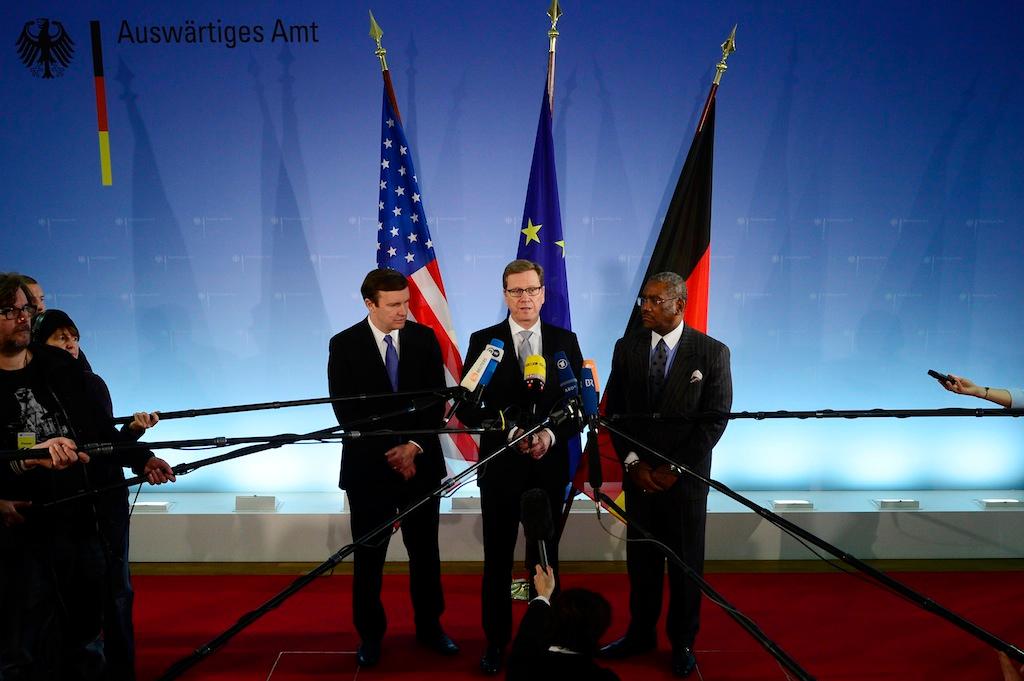
Senator Chris Murphy, German Foreign Minister Guido Westerwelle and US Congressman Gregory Meeks meet in Berlin on a ‘goodwill’ mission to discuss NSA spying on Chancellor Angela Merkel and other leaders on Nov. 25, 2013.
A spokesman for German Chancellor Angela Merkel's conservatives told Focus news magazine on Saturday that US contracting companies that work with sensitive German data should be banned from sharing that data with the NSA.
According to multiple reports, Hans-Peter Uhl, the conservative parliamentary spokesman on interior policy, told the magazine that Cisco, which works with data from Germany's armed forces, should be contractually obligated against giving data to the US intelligence agency.
Earlier this year reports claimed the NSA had tapped phones in Europe, including Merkel's cell phone. (On Friday, the Washington Post reported UK and US spy agencies had targeted a European Union official who "oversees antitrust issues involving U.S. tech firms.")
Germany, perhaps more than other countries, has voiced its anger over the revelations of the NSA's activities, provided by former contractor Edward Snowden, who is now living in Russia.
The Times, citing and unnamed person who spoke with Merkel, had reported that the chancellor had told President Obama that NSA spying was "like the Stasi," the repressive spy agency of communist East Germany. However, an unnamed US official told Times that Merkel's remarks were not that dramatic.
Even Snowden does not think his NSA revelations merit a clear comparison with the Stasi.
"The NSA is surely not the (East German) Stasi, but we should always remember that the danger to societies from security services is not that they will spontaneously decide to embrace mustache twirling and jackboots to bear us bodily into dark places, but that the slowly shifting foundation of policy will make it such that mustaches and jackboots are discovered to prove an operational advantage toward a necessary purpose," he told Time in an email interview.
Against such pervasive criticism at home and abroad, Obama has said there needs to be a compromise, saying checks and balances were needed, but that "we can't unilaterally disarm."
The story you just read is accessible and free to all because thousands of listeners and readers contribute to our nonprofit newsroom. We go deep to bring you the human-centered international reporting that you know you can trust. To do this work and to do it well, we rely on the support of our listeners. If you appreciated our coverage this year, if there was a story that made you pause or a song that moved you, would you consider making a gift to sustain our work through 2024 and beyond?