PRX is a 501(c)(3) organization recognized by the IRS: #263347402.
AI is rapidly changing math, and mathematicians are defining their role in the equation
Artificial intelligence is a game changer across many fields these days and mathematics is no exception. Yet, the rapid acceleration of its ability to solve some of arithmetic’s most challenging proofs has left many a mathematician wondering how they fit into future equations. The World’s Host Marco Werman spoke to one such human mathematician, Daniel Litt, at the University of Toronto.
Abigail Schneider, 8, completes a level of her learning game on a laptop computer, Wednesday, Dec. 8, 2021, in the Brooklyn borough of New York.
John Minchillo/AP/File
The 2001 Australian thriller “The Bank” introduces us to a boy in elementary school who is precociously gifted in mathematics. As an adult, he takes his deep knowledge and uses complex computational models to manipulate the world of finance.
What would the benefit to society be? We could predict the next market crash. This type of mathematics allows us to predict almost anything.
We’re in the midst of another mathematics revolution right now, and it’s not on the movie screen — it’s happening because of artificial intelligence.
Daniel Litt, assistant professor of mathematics at the University of Toronto, joins Host Marco Werman to discuss what AI may be capable of doing mathematically.
Marco Werman: So, Daniel, you predicted last year that there was only a 25% chance AI could best [top human mathematicians] in writing a mathematical paper by 2030, and you already had to revise that forecast, is that right?
Daniel Litt: So, what I would say is that I was pretty skeptical just a year or two ago that AI tools would be able to autonomously do research at the level of the top mathematicians, today, within the next five or six years. What I think is likely true, based on the current rate of improvement, is that they’ll be able to conduct high-quality research autonomously. That said, I would expect that if that’s happening, humans working with AI tools would do even better research.
Right, and that is a key point, but a big leap in a year. How exactly is AI changing the field of mathematics?
Yeah, so right now, I would say a good rule of thumb is that AI tools are able to do mathematical tasks that someone, maybe a world expert in a given area, would find easy. So, that’s really useful, as individual mathematicians aren’t experts in everything, and being able to do something someone else finds easy is very powerful.
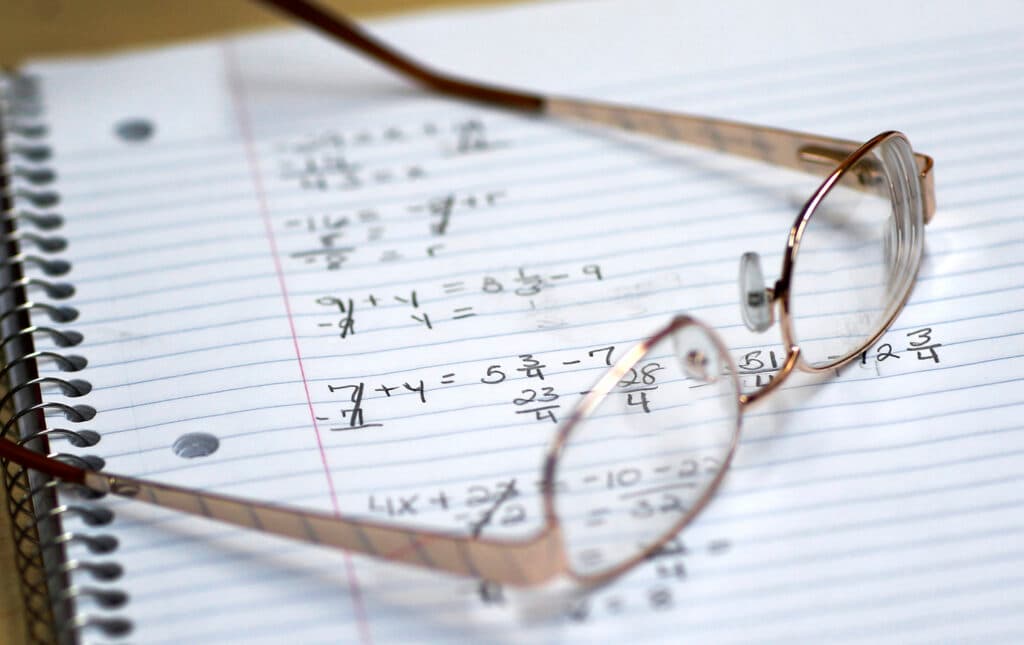
This photo taken March 12, 2014, shows a student’s glasses sitting on a notebook containing math exercises in a remedial mathematics course at Baltimore City Community College in Baltimore.Patrick Semansky/AP/File
Right, so that’s one way AI is changing the field of mathematics. Take us to other changes.
Well, maybe let me just step back a little bit. So, two years ago, the models could do very little. They would struggle with basic arithmetic. One thing that’s changed a lot in the last couple of years is they’ve gotten very good at coding, and they’ve gotten more reliable with proof, so rigorously checking that a mathematical statement is true. In my view, the two ways the models have become useful for mathematical research are, first of all, they can prove statements that would maybe previously be required by an expert to prove. And they can do very involved coding tasks that let you kind of explore a mathematical phenomenon in some detail, which would have been challenging and would have been much more time-consuming previously.
Right, so we know that AI has its blind spots. I remember recently seeing that some AI chatbots struggle to answer how many Rs are in a word like strawberry. ChatGPT apparently did learn that, though. How do we know then that AI has solved a previously unsolved problem when that time comes?
One challenge with using these models is that they’re not truth-seeking, so they’ll often produce something they claim is a proof, which may or may not be correct. And it’s very difficult to check. So, in fact, a lot of using the models to do mathematics is … they generate some claim, and then one has to check it … and that’s challenging.
So, humans still have to check the AI. When do you think that’s going to change, or will it ever change?
I think it’s quite likely that it will not change for some time, you know, auto-formalization work has the promise of making some AI mathematics more reliable. But yeah, we’ll see how long that takes. Certainly, I don’t expect that to be practical in all areas of mathematics within the next couple of years.
So, Daniel, how would you describe what’s at the heart of the debate about AI’s role in the future of mathematics?
Right now, the capabilities of these tools are to do tasks that would have previously required an expert, but were more or less routine for experts. And then the question is when and if the tools will be able to do non-routine tasks. Based on the trajectory of capabilities, I expect that it will happen soon in the next couple of years, maybe. My personal expectation is that we should expect to see AI tools doing high-quality autonomous research in the next five years, but definitely, that’s not a unanimous view in the mathematics community.
Daniel, in the past, I imagine computers were used to help confirm mathematical equations. Are we seeing a role reversal?
So, historically, the way computers have been used in research is, well, you generate a huge number of examples and analyze them. Then there are a few cases of proofs that break up into hundreds or thousands of cases, and many of those cases can be resolved by a computer. So, famously, the proof of the four-color theorem, which is that you can color a map with four colors so that any two adjacent countries have different colors, required some computer aid. You should think of the current use of AI tools as a natural continuation of that.
I remember when I was in junior high school and handheld calculators became affordable enough for kids to bring to school. And then there was a debate about whether that inhibited our development of problem-solving skills. Is AI the next stage in that debate, or is this fundamentally a different conversation?
I think, personally, that it’s a natural continuation of that question. Anytime you develop a new tool, it both enhances our capabilities by using it and makes certain old capabilities and techniques less useful and relevant. I think that’s just the natural progression of technology: You gain capabilities, and then the tool itself substitutes for some of the capabilities you needed previously. I think that’s okay.
I want to return to the clip we heard from that movie, “The Bank.” I mean, how could all of these changes impact things in the world of finance, for example, where math is really important, or policy making, where decision outcomes are often assigned a probability?
That’s a great question. One exciting thing about the tools is that they’ll broaden the availability of mathematical techniques, so I think people who previously would not have tried to make a mathematical model for something might now have the capability to do that. You don’t need as much expertise to use the tools to do mathematics as you needed to do it without AI tools previously. There’s some danger in that, I think, one can misuse a tool, of course. But yeah, my hope is that they’ll lead to a democratization of mathematics and more people thinking mathematically and asking interesting mathematical questions.
Parts of this interview have been edited for length and clarity.