PRX is a 501(c)(3) organization recognized by the IRS: #263347402.
The Big Fix: Lessons from Uruguay
The small, South American country of Uruguay is an energy transition success story. Once importing most of its fuel, the country now generates almost all of its electricity from renewable resources. The World’s Host Carolyn Beeler speaks with Ramón Méndez Galain, the man behind the success story.
The Customs Building, center, is illuminated by a setting sun at the port in Montevideo, Uruguay, Thursday, March 7, 2024.
Matilde Campodonico/AP
The South American country of Uruguay is today considered an example of what a successful energy transition looks like.
The country — sandwiched between Brazil and Argentina with a population of just under 3.5 million — generates about 98% of its electricity from renewable sources, primarily wind and solar. And it’s had a long-term transition plan, backed by the entire political system, in place for more than a decade.
The man behind this success story is Ramón Méndez Galain. He served as Uruguay’s energy secretary from 2008 to 2015, where he overhauled, not only the country’s energy mix, but the entire system the sector was built on. Today, he works with other nations to help them craft their own energy transitions.
“The transition is possible, but we have to change the rules of the game,” he said during a lengthy conversation with The World’s Host Carolyn Beeler.
Méndez spoke with The World for the latest installment of The Big Fix.
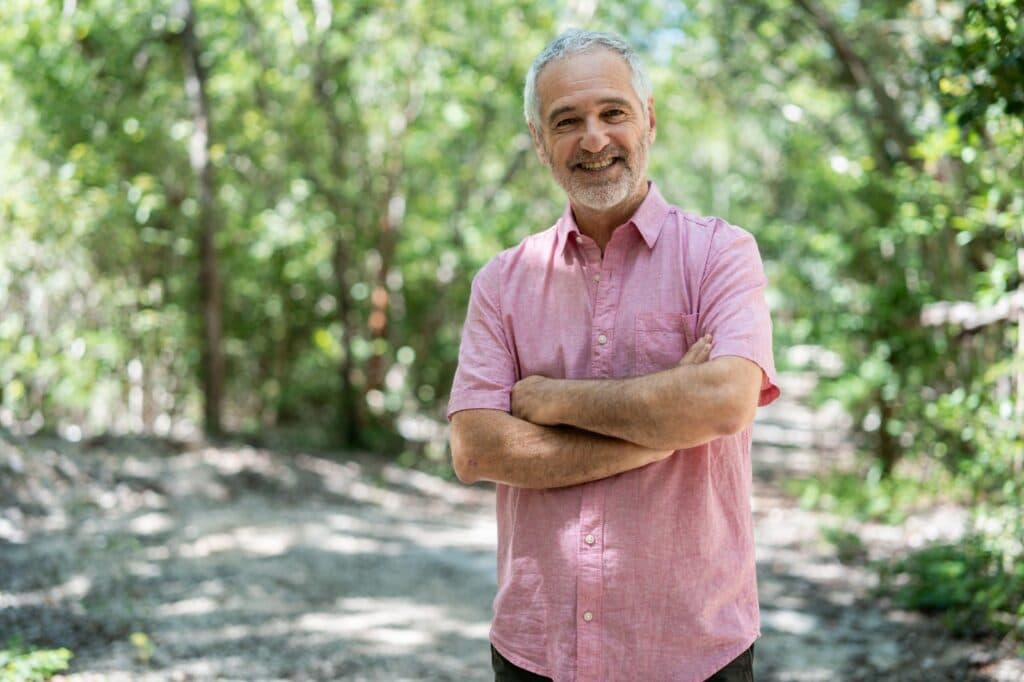
Ramón Méndez Galain served as Uruguay’s National Director of Energy from 2008-2015. He now runs the nonprofit Ivy.Courtesy of Ramón Méndez Galain
Carolyn Beeler: Take us back to 2008, when you became the country’s energy secretary. Where was Uruguay’s electricity coming from?
Ramón Méndez Galain: Uruguay has traditionally had a lot of hydropower. So, it was a combination of hydropower plus fossil fuel derivatives … to produce electricity. But [the energy mix] was becoming more and more dependent on fossil fuels. And on top of that, our hydropower mix is very complicated because we are dependent on a weather phenomenon, El Niño. So, we can have dry years when hydropower can deliver half of a regular year.
So, it was a really, really complicated issue. The prices were going up, we’re beginning to have blackouts and also the economy was growing very fast. I mean, the economy was growing at 5, 6, even 7% per year. So, the energy demand was growing. [It] was really, really a big problem at that time.
So, oil and gas prices were going up while hydropower was going down and you had to come up with enough electricity for your country. Was there the goal of shifting to renewables at the outset? And if so, how did you think about starting to approach that massive shift in your electricity grid?
It was absolutely a conscious decision because, in fact, we don’t have any kind of fossil fuel reservoirs [in Uruguay]. So, all fossil fuels we needed to use, we needed to import.
So for us, going to renewables was having more energy sovereignty, energy independence. It was just about the independence of the country itself. We’re a small country, small economy. So, being independent was absolutely crucial. …
Of course, we [also] needed to reduce emissions. We understand that [the] climate issue is really a problem … So, it was a combination of facts.
But of course, we had to prove two things. The first thing is that we could reduce cost using renewables.
So, that it would actually be cheaper for everyone to switch to renewables.
Absolutely. I can spoil [the ending] in telling you that, in fact, we succeeded to decrease, by a factor of two, the cost of electricity. Because now it’s very clear renewables are the cheapest option.
And decreased by a factor of two, you mean that the price to generate electricity went down by half?
Yeah, it went down from about $10 per kilowatt hour to about $5 per kilowatt hour. This was the result of going from 50% fossil fuel mix to only 2% fossil fuel mix. …
The second point we had to prove is that a power system can work with more than 98% of renewable energy. And this was not clear. Even now, many people are still saying that it’s not impossible to manage intermittency, because we know solar and wind are intermittent sources. So, we had to prove that it was possible to have a combination of different renewable technologies, and this combination brings us the security of supply in all kinds of scenarios.
So, this was technical, [and] very complicated, but at the end of the day, [it was] a technical issue that we have solved. And yes, it was not a simple task, but it’s not rocket science … just dealing with the intermittency was a complicated but feasible problem even for a small economy, for a small country like Uruguay. Human engineering has succeeded [putting] a man on the moon more than 50 years ago. So, dealing with variability of solar and wind was not that complicated.
If you had to pick one or two headlines about how you made this happen, what would those be? Why did this work?
It’s very simple.
The answer is that our power system, all the structures and all the way we plan the system, the way that we operate the system, everything, all this structure has been defined according to the characteristics of fossil fuels.
And that’s not bad because, for decades, they were the best solution. But if you really want to include renewables, with all the benefits they can provide, we have to redefine the system. It’s not just changing one fuel to another fuel. It’s redefining the system.
This means new regulation, new market designs, new ways of planning the system, for operating the system. There are a few technical issues that have to be solved, but also the market design itself needs to be changed because fossil fuels, at the end of the day, in order to produce electricity, what you have to do is to pay for the fuel. But when you have renewables, there’s no fuel. I mean, the fuel is free. So, everything has to pay back an investment.
[It] is a kind of financial business, and not an industrial business, in the sense of the word. So, it has completely different kinds of investors that you need, the risk perception is absolutely crucial, the capital cost is absolutely crucial. So, everything needs to be redefined. And in fact, in a way, we were brave enough in order to understand that we really needed to change everything.
And changing everything, as you have said, this wholesale reimagining of how we produce and transmit electricity, that’s a dramatic change and it happened very quickly.
Did you get a lot of pushback from folks at home, from other politicians?
When I entered [as] Secretary of Energy, one thing I rapidly understood is that in order to maintain the boost for the transition, we needed an important political agreement. And in fact, the long-term policy that we wrote, we shared it with all political parties represented in parliament and we succeeded [in having] the approval of all political parties.
And this was crucial because this brings a lot of confidence for investors. And once again, as risk perception is crucial in this kind of new technology, having a long-term agreement which was backed by the entire Uruguayan political system was the panacea for investors. And that’s why, yes, in a few … years, we succeeded to have about a $6 billion investment. For a small economy like Uruguay, $6 billion is 12% of the total GDP of the country. So, it was a tremendous boost for the economy.
We heavily invested in introducing, first, wind and solar and biomass waste, which used to be an environmental liability and now biomass waste is used as an energy source.
Although it can be debated whether that’s actually a green energy source or carbon neutral.
Yes, I mean, overall, it’s a combination of hydro, wind, solar and biomass waste. And this is 90% of the whole sources. But it’s a very, very simple technical detail. When I say we change everything, we mean, for example, that usually all over the world, the power system base load, which is the base of the system, is nuclear power, or coal plants, or combined cycle using gas plants. [But] in Uruguay is wind and solar. The total installed capacity of wind and solar is equal to the peak demand of the country. So, this means that when we have enough wind and enough sun, 100% of electricity is just wind and sun. And all the rest is there just to follow the variabilities of wind or sun. So, we use water when we need it, not when there is water in the reservoirs. When we have wind and solar, we don’t use water from the reservoir. We only use the water when there is no sun, when there’s no wind. So the role of the whole system is to follow the variability of wind and solar. [We do] still have some fossil fuel plants, but they’re not the base of the system. They are just a kind of insurance policy. When all the rest fails, then we use fossil fuels. But this is only 2% [of the system]. Last year, [fossil fuels were] only 1% of [all the] electricity the country used. So, that’s why I’m saying that we have to redefine all the ways the system operates and all the definitions of how the power system usually works. … We proved it was possible.
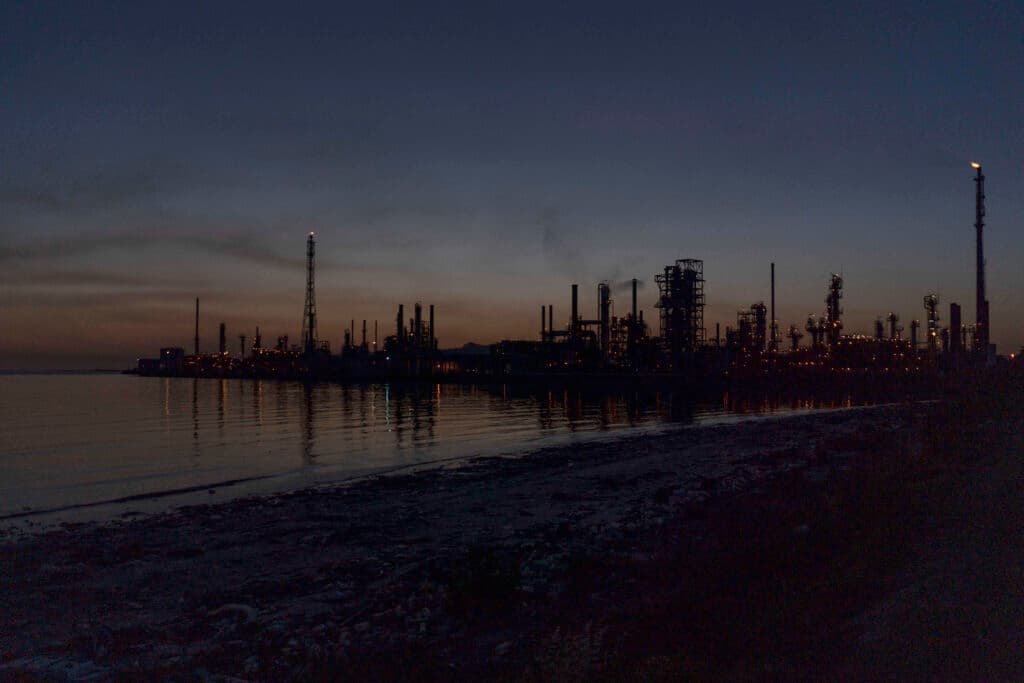
A state owned oil refinery sits alongside the bay as the sun sets in Montevideo, Uruguay, Monday, Dec. 2, 2019. Matilde Campodonico/AP
You have named some quite unique aspects of the situation in Uruguay that made this possible, namely that much of the electricity was generated by imported fossil fuels, making solar and wind comparatively cheaper, and also giving a reason to want to promote homegrown electricity.
So, is this an approach that can work elsewhere?
Absolutely. But of course, not spontaneously.
First of all, today, even if you are an oil producer country or a gas producer country, wind and solar are the cheapest option. Take, for example, Colombia. In Colombia, they produce oil, they produce gas, they produce coal, but producing electricity using wind and solar is cheaper than using their own gas and coal because technologies have decreased the cost.
What happened in the last 20, 30 years, is that thanks [to efforts to] stop climate change, there were incredible developments of solar and wind technologies. And so, the cost has decreased dramatically. Photovoltaic cells have decreased by a factor of 8 in only 10 years.
But a second point concerning the economy, which is perhaps more interesting, is when you go to wind and solar, you become independent of [the] crazy fluctuations of oil and gas and coal prices. Because when you have … geopolitical events in the world, [for example] an invasion of one country of the other, this is reflected in the prices of oil and gas. But when you’re using sun and wind, they’re free. So, this is absolutely independent of these global events.
So, it’s not only that you decrease costs, but you stabilize costs. And this is crucial for the economy, because it doesn’t impact your inflation and the macro economy of your country. So, for all kinds of countries, going to renewables today is no longer just because of a climate issue. Going to renewables today is a better solution than we can have today.
Today, you work with other Latin American countries trying to make similar transitions as your country did. You mentioned Colombia. I’m wondering if you’ve seen progress anywhere near as fast as you made in Uruguay elsewhere.
No, unfortunately not so far.
The transition is possible, but we have to change the rules of the game. And we have incumbents, we have rulers and we have people who have their interests, so changing the rules in the game is not always as simple. And when there is a dominant narrative, when there’s a dominant structure of the game which is dominated by a few actors, then change in order to benefit other actors is not simple.
So, what we work on in many countries is trying to show that there is a new narrative, which is not the dominant one, but is the real one. The new narrative is that transition is the best solution. But in order to do it, the politicians have to understand that they need to make changes, because otherwise the market by itself cannot make it.
I wonder, in Colombia or elsewhere that does have an oil or gas industry within the country, is pushback from the industry invested interests, is that one of the challenges of making this transition in a place that has its own fossil fuels, unlike what your experience was in Uruguay?
Absolutely, absolutely. This is one of the main difficulties.
But at the end of the day, who is ruling? I mean, because it should be the interests of the people, for the consumers … to reduce costs, … to stabilize costs. I’m not only talking about the houses, households, I’m talking about industry. So, the governments are not taking the appropriate decision because they don’t want to face the incumbents … but the corporates understand that now going to renewables is the best option for them.
This is what is happening today all over the world. I mean, take, for example, the case of China. They have heavily invested in renewables, not just because of climate change, they have invested in the renewables because its the cheapest option. And half of the total investment last year in renewables was done just in China. They invested about $7 trillion just in one year. And this is because it works. This is because this is the best solution. But … we have to understand what the benefits are and people need to understand what the benefit are in order to go in the appropriate direction.
People walk on the beach as the sun sets in Montevideo, Uruguay, Saturday, Oct. 25, 2014. Natacha Pisarenko/AP
If you were able to give one piece of advice, one sentence, to other energy secretaries out there who would like to do the same thing you did, what would it be?
[There are] two sides of the same coin.
[The] first side is, this is possible. Don’t be afraid of that. And this is possibly the best solution, even if climate change didn’t exist, … for our own country, [our] national interest.
And second … you have to be brave enough to understand that the present rules of the game have a tremendous bias forcing the continuity of the present system. If you’re going to take advantage of the new technology that has been developed and matured in the past years, you have to change a lot of regulation and you have change the market design.
This interview has been lightly edited and condensed for clarity.