PRX is a 501(c)(3) organization recognized by the IRS: #263347402.
Glitter makes Rio sparkle at Carnival. It also pollutes the environment.
In Rio de Janeiro, Brazil, hundreds of thousands of people cover themselves in glitter for the biggest party in the world, Carnival. However, most of that glitter is made from plastic, which pollutes the environment. The World’s Host, Marco Werman, spoke with the researcher Juan Diego Rodriguez-Blanco about the problem with glitter and the alternatives available.
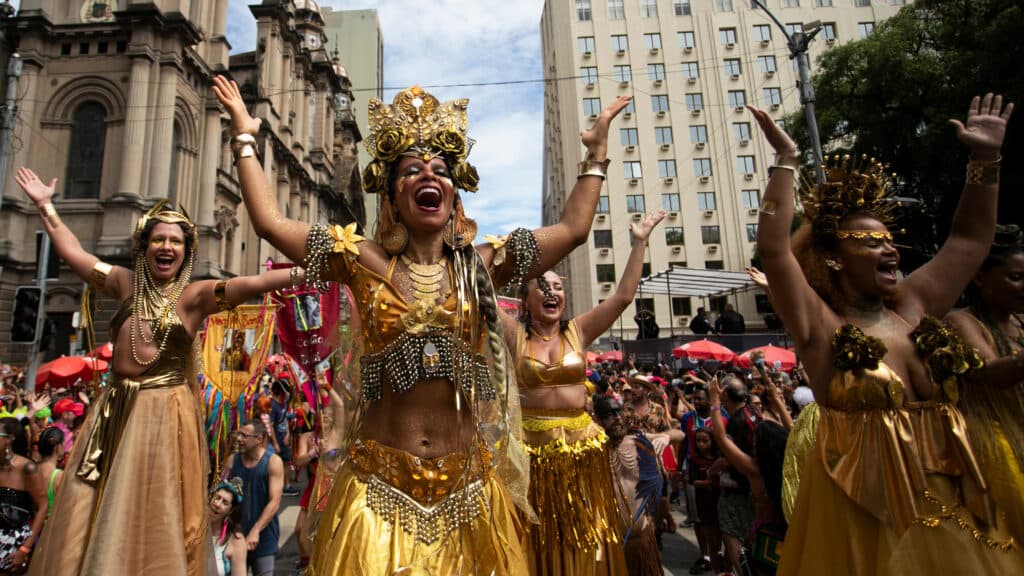
A performer from the Grande Rio samba school parades during Carnival celebrations at the Sambadrome, in Rio de Janeiro, Feb. 18, 2026.
Silvia Izquierdo/AP
The big dance competition has concluded at Carnival in Rio de Janeiro, Brazil, bringing the eight-day party to an end, and now comes the aftermath. The celebration leading up to Lent involves some 2 million people descending on the city. The hundreds of thousands of revelers are known to cover their costumes, their clothing and themselves in glitter for Carnival.
However, most of that glitter is made from plastic, which pollutes the environment. And when it comes to cleanup, that is one big shiny mess. The World’s Host, Marco Werman, spoke with Juan Diego Rodriguez-Blanco about the problem with glitter and the alternatives available. He is an investigator at Trinity College Dublin, and explained that, besides it being a tradition, the glitter is also a major source of plastic pollution.
Stilt walker Raquel Poti, center, performs at the Cordao do Boitata” street pre-carnival party in Rio de Janeiro, Feb. 8, 2026.Bruna Prado/AP
Marco Werman: What is glitter actually made of?
Juan Diego Rodriguez-Blanco: The base of glitter is a microplastic that we usually call polyethylene terephthalate, PET. This is the base, which is the main microplastic. And then above this main layer of plastics, they put layers of different dyes or different organic compounds that produce the color. And what happens with these microplastics is that sooner or later, these microplastics will end up in wastewater. And that wastewater ends up in seawater. It is very attractive for marine fauna. What I mean is that the fish are going to be attracted by the colors, [and] will eat that. Also, these plastics will tend to break into smaller pieces, and they are very, very difficult to control, and they’re what we call newer contaminants.
You described the problem of glitter for marine life. One has to assume that glitter accumulates, though, year after year. It’s not like they can clean up Carnival 2026, and they say the problem’s done. Is that correct?
Yeah, exactly. The problem is that we are not dealing with glitter from 2025 or 2026. We are dealing with glitter and other microplastics that have been in the oceans for years and years and years. And the problem is, they take plenty of time to degrade. And they break [down into] very tiny plastics that we call nanoplastics. Nanoplastics are amazingly small plastic particles. And just to give you some numbers, one single glitter particle, it can break into [somewhere] between 10 and 20 billion nanoplastics.
What? One piece of glitter?
Yeah, one single glitter particle, and that ends up everywhere.
So, when people straight up rub this stuff on their bodies, then what happens?
I mean, the problem is that we don’t know. Scientifically speaking, we know that it’s not very good to have a diet that contains microplastics, no? But what happens if those microplastics end up in our bloodstreams? I mean, there is research indicating that these potentially could produce heart attacks, for example. This kind of research is in its infancy. We need to do a lot of research on microplastics and their effects on our bodies, and other living creatures, in the oceans, in the carbon cycle, everywhere.
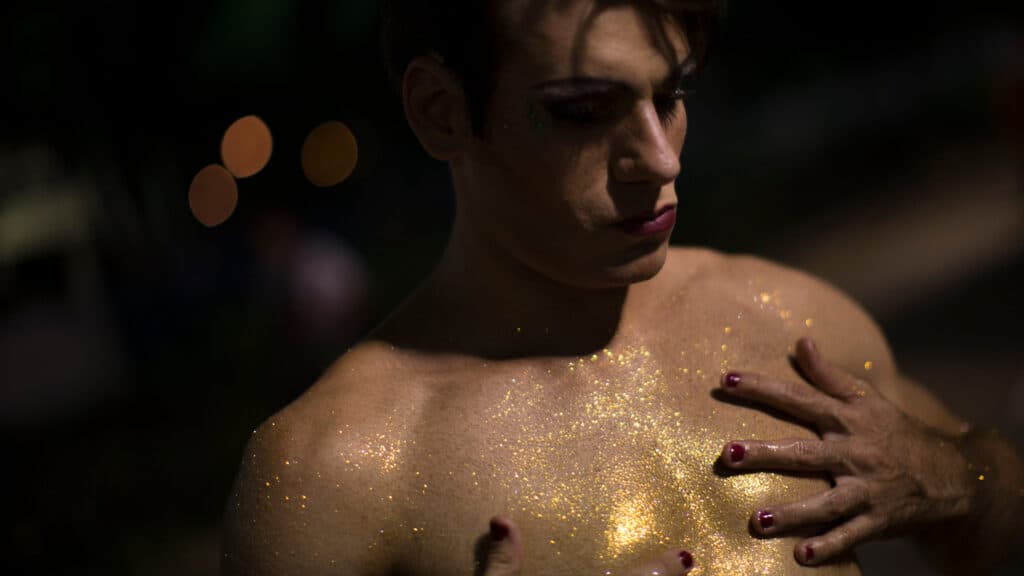
A performer from the Mocidade samba school applies glitter before parading through the Sambadrome during carnival in Rio de Janeiro, Brazil, March 3, 2014. Felipe Dana/AP
Juan Diego, I’m worried that you’re going to tell us we have to cancel glitter, but is there an alternative?
In theory, there is an alternative. There’s something that we call eco-friendly glitter. And this is glitter that is made of a specially modified cellulose, which is coming from hardwoods of eucalyptus, for example. But the problem is not that. The problem is that we already have disposed of too much rubbish, too much plastic rubbish in the oceans. So, this eco-friendly glitter is obviously very nicely welcomed. But the problem is what we have been doing [over] the last 50 years.
And so, what efforts have been underway to encourage the use of those alternatives?
The first thing is to try to ban microplastics or glitter. But glitter is not only used in parties or in carnivals. It is used also for fashion. It is used for fishing. The military is using glitter in ways that we don’t know. It’s used in boats, in ships. So, it’s not so simple, you know what I mean.
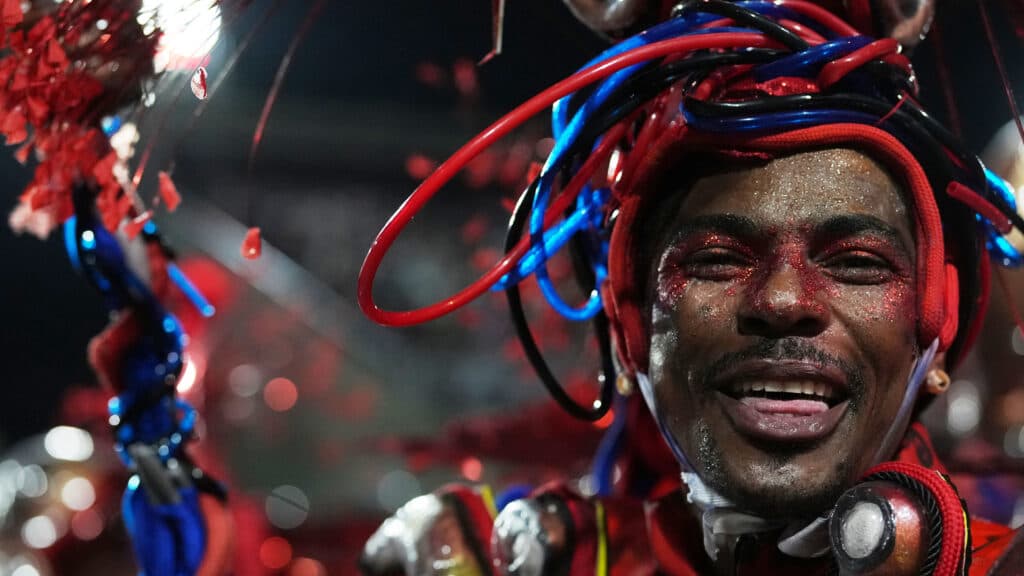
A performer from the Grande Rio samba school parades during Carnival celebrations at the Sambadrome, in Rio de Janeiro, Feb. 18, 2026. Silvia Izquierdo/AP
Well, other countries have actually banned plastic glitter and have seen a lot of growth in biodegradable glitter products. The EU apparently has banned glitter in cosmetics. So, I’m wondering why haven’t these moves taken hold in Brazil?
The problem with this is that one thing is to ban the product, but another thing is [that] this ban is not going to be immediate. It’s also a matter of money. What I mean is that it may be cheaper and easier to produce glitter made of plastics compared to eco-friendly glitter. So, it’s not something that’s just going to happen in 24 hours. This is going to take years.
Let’s face it, glitter is a lot of fun, clearly a central part of Carnival in Rio. What is your message to people about how to keep sparkling and staying fabulous, but also just being more environmentally friendly?
Well, the message is very simple. If you’re using glitter, this is something that you can have fun with. But in the end, it’s going to end up in our bodies because marine life is going to eat that. And sooner or later, I mean, this is a cycle. We are eating our own rubbish. I’m sorry to say that clearly, but this has ended up in our bodies and we need more research on this. Otherwise, we are not going to know the consequences of disposing so much glitter and microplastics in the ocean.
Parts of this interview have been lightly edited for length and clarity.