European passport checks could resume amid flood of migrants
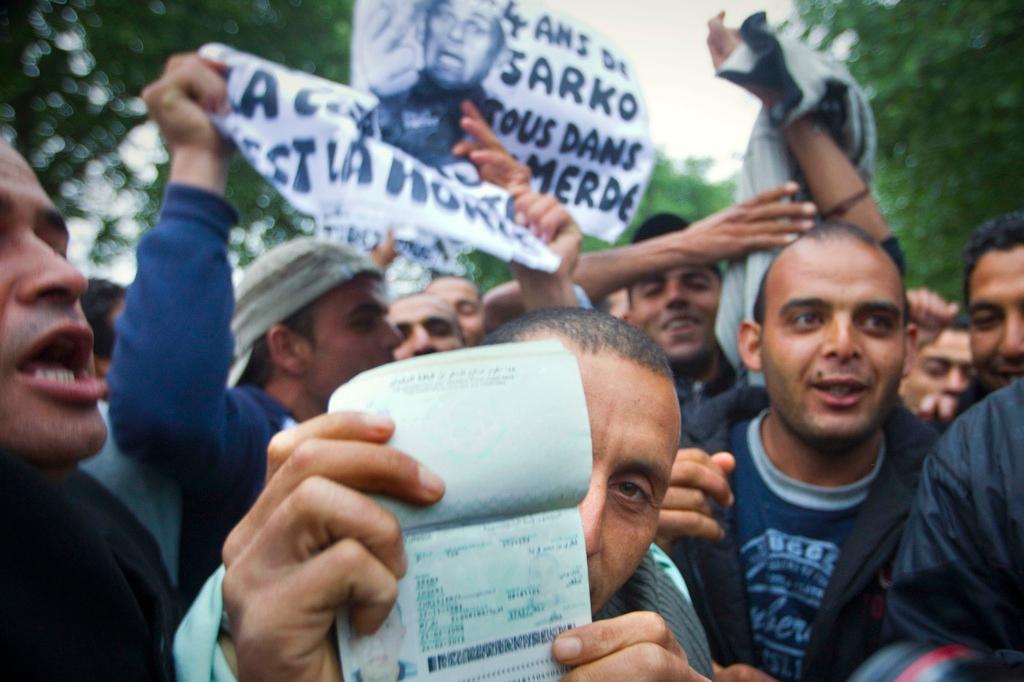
A Tunisian citizen shows his passport on April 28, 2011 in Paris, during a demonstration to protest against French state’s politics regarding Tunisian migrants. France called on April 22 for an upgrade of Europe’s Schengen visa-free pact, calling the system flawed as it battles to stem an influx of migrants from Tunisia and Libya through Italy.
Limited passport checks could be reintroduced at European internal borders under a plan to tackle the extraordinary flow of North African asylum-seekers.
European Union governments in the passport-free Schengen zone could temporarily reimpose border controls under the proposal from the European Commission, which is the union’s executive body.
“To safeguard the stability of the Schengen area, it may also be necessary to foresee the temporary re-introduction of limited internal border controls under very exceptional circumstances, such as where a part of the external border comes under heavy unexpected pressure,” EU home affairs commissioner Cecilia Malmstroem said on Wednesday in Brussels, according to Bloomberg.
Malmstroem was at pains to stress any passport checks would be limited and temporary. But passport-free movement is a cornerstone of the EU and mere talk of tighter border control reflects the depth of concern about the flow of migrants.
“Secure borders does not mean that we are constructing fortress Europe,” she said, according to the BBC. “It must still be possible for people to seek international protection in the European Union and we must also keep it open for the labour migration that we so desperately need.”
With the exception of Britain and Ireland, which still have passport checks, Europeans can travel freely across the union as well as non-EU-members Iceland, Norway and Switzerland, without having to show documents.
About 25,000 migrants have arrived in Europe through Italy this year, most of them from Tunisia. Italy angered its neighbors by granting temporary residency permits to many migrants, which allows them to travel.
France in particular was furious and stopped a train carrying African migrants at its border.
Italy complains that it is not getting enough help from its EU partners, faced with the influx of people fleeing political turmoil and violence in Tunisia and Libya.
French President Nicolas Sarkozy and Italian Prime Minister Silvio Berlusconi then joined forces in calling for a revision of Schengen.
The commission will hold consultations before making any decisions. EU interior ministers will discuss the issue on May 12.
Malmstroem called for the whole of the EU to help nations such as Italy and Malta cope with a migration surge.
Before the North African unrest Greece's border with Turkey was the main EU entry point for illegal migrants.
"We should not leave it only up to the member states at our external borders to deal with extraordinary migratory situations," Malmstroem said.
Every day, reporters and producers at The World are hard at work bringing you human-centered news from across the globe. But we can’t do it without you. We need your support to ensure we can continue this work for another year.
Make a gift today, and you’ll help us unlock a matching gift of $67,000!