ElBaradei to run for president in Egypt
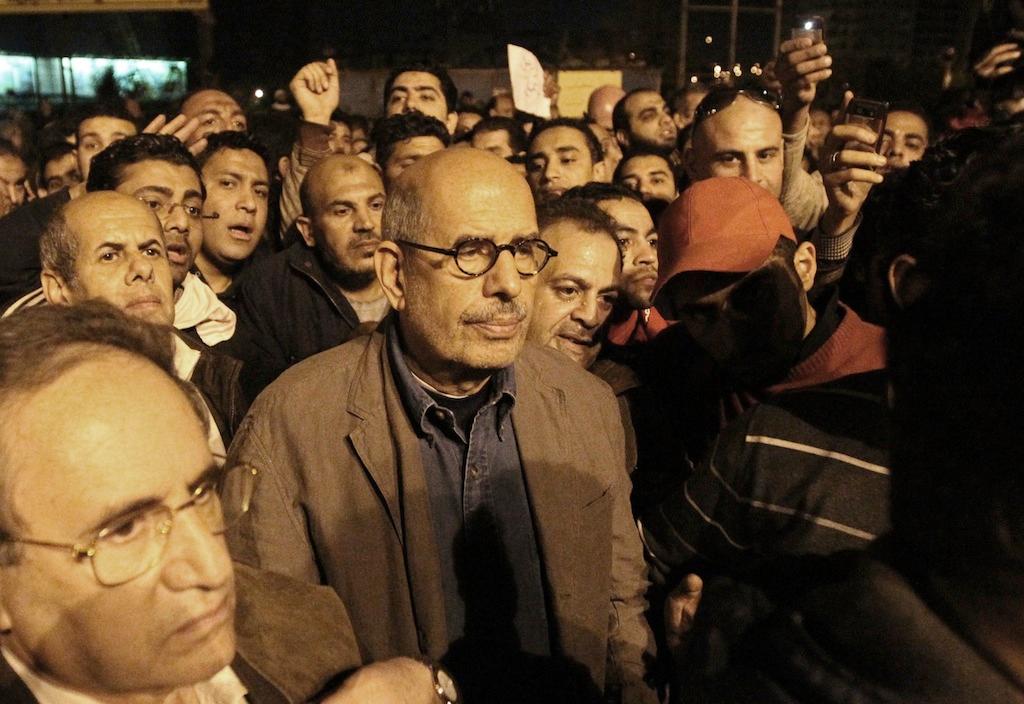
Egyptian Nobel Peace laureate and reformist Mohamed ElBaradei is surrounded by supporters as he arrives to address demonstrators at Tahrir Square in Cairo on Jan. 30, 2011.
Egypt's reformist Mohamed ElBaradei said Wednesday he plans to run for president in national elections expected to be held this year.
ElBaradei, a Nobel laureate and former head of the UN nuclear watchdog agency, said on a live talk show that he will nominate himself to run when the time comes, Reuters reports.
ElBaradei returned to Egypt in January as the country faced protests that led to the ousting of dictator Hosni Mubarak, who ruled Egypt for three decades. He has tried to position himself as a leader of the protesters and now the new country.
On the talk show, ElBaradei also called on the Supreme Council of the Armed Forces, which has been running the country since the revolution swept away Mubarak, to delay or cancel an upcoming referendum on constitutional amendments. He called the amendments "superficial."
"We are going in the opposite direction. I call on the military council to delay or cancel the referendum," he said.
Critics have attacked the army's plan to hold elections within six months because they say it does not give new parties time to form and generate support. There is a fear that they only parties that will be able to succeed will be remnants of the National Democratic Party and the Muslim Brotherhood.
"If we go ahead with these amendments this means we would have parliamentary election within two months where 80 percent of Egyptians, the silent majority, would not have a chance to participate in a real parliamentary process," said ElBaradei.
"It would only be a parliament of the remnants of the National Democratic Party and the Muslim Brotherhood."
The proposed amendments also limit a presidential term to two four-year terms, reports Al Jazeera.
ElBaradei is the former head of the International Atomic Energy Agency (IAEA).
— Hanna Ingber Win
Every day, reporters and producers at The World are hard at work bringing you human-centered news from across the globe. But we can’t do it without you. We need your support to ensure we can continue this work for another year.
Make a gift today, and you’ll help us unlock a matching gift of $67,000!