PRX is a 501(c)(3) organization recognized by the IRS: #263347402.
Clashes between Afghanistan and Pakistan raise concerns about ‘open war’
Overnight on Feb. 26, Pakistan’s military fended off attacks by the Taliban along the border with Afghanistan. The country’s air force retaliated the following morning with targeted airstrikes in Kabul and Kandahar. It’s the latest outburst of tensions between the two neighbors. As the rhetoric ratchets up, The World’s Host Carolyn Beeler learned more from Ibraheem Bahiss, a senior analyst with Crisis Group. He joined the show from Kabul.
Villagers examine damages due to overnight cross border fighting between Pakistan and Afghan forces, at a village in Bajaur, a district of Pakistan’s Khyber Pakhtunkhwa province bordering with Afghanistan, Feb. 27, 2026.
AP
There were fierce nighttime border clashes between Afghanistan and Pakistan last Thursday. Pakistan’s Defense Minister Khwaja Asif wrote on X, “Our cup of patience has overflowed. Now it is open war between us and you.” Pakistan accuses its neighbor of becoming a proxy for India and a haven for terrorist groups — including the insurgent group Tehrik-e-Taliban Pakistan, a Pakistani Taliban offshoot.
The two countries have been engaged in ongoing hostilities for several months, and on Feb. 27, Afghan Taliban troops stormed dozens of Pakistani border positions. The Pakistani Air Force responded with airstrikes, hitting the capital Kabul and Kandahar.
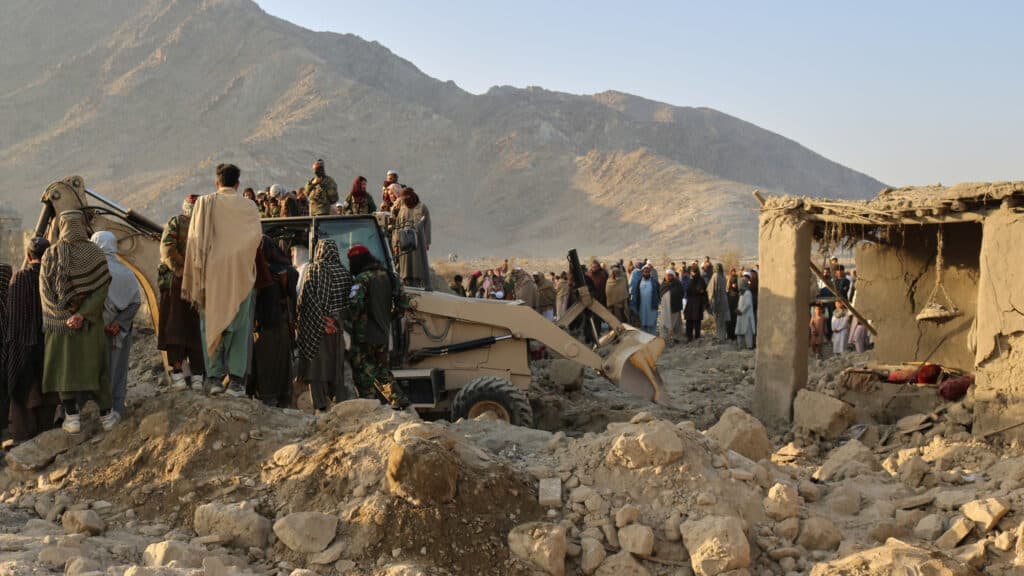
Local residents and civil defense workers look on as a bulldozer clears the rubble of a house hit by a cross-border Pakistani army strike in the Behsud district of Nangarhar province, Afghanistan, Feb. 22, 2026. Hedayat Shah/ AP Photo
To better understand the matter, The World’s Host Carolyn Beeler spoke to Ibraheem Bahiss, a senior analyst in Kabul with the International Crisis Group.
Carolyn Beeler: Can you tell me what it was like overnight in Kabul?
Ibraheem Bahiss: It was around 3 a.m. that we heard a loud boom and sounds of explosions here in Kabul. And there were some faint sounds of jets in the skies, as well. Besides that, there were no further sounds or movement here in Kabul besides this incident that I mentioned. On social media, it became quite apparent that some, likely a military installation, had been targeted, although there has been no official confirmation on casualties and targets as of yet.
Kandahar, Afghanistan’s second largest city, was also targeted. What kinds of sites were hit there, and do we know anything about casualties there?
So, this is the second time that Pakistan has carried out airstrikes, both in Kandahar and Kabul. The last time was in October last year, again in response to a major Taliban ground offensive, which was again in response to airstrikes by Pakistan inside Afghanistan. This time, however, the Pakistani media’s messaging has been that the targets were military, both in Kandahar and Kabul, and whereas last year for example, downtown Kabul was hit, this time it was a more isolated location. So, it seems that at least it was not a crowded area that was hit in this latest round, both in Kabul and in Kandahar, but rather quite possibly it could be military installations. Yet again, we cannot state with certainty because Kabul has not yet confirmed it on their end.
As you have said, this is part of a larger pattern of tit-for-tat violence. Tell us what is at the root of this conflict.
The core issue between the two neighbors stems from the Tehrik-e-Taliban Pakistan, which is a militant group that emerged in Pakistan around 2007.
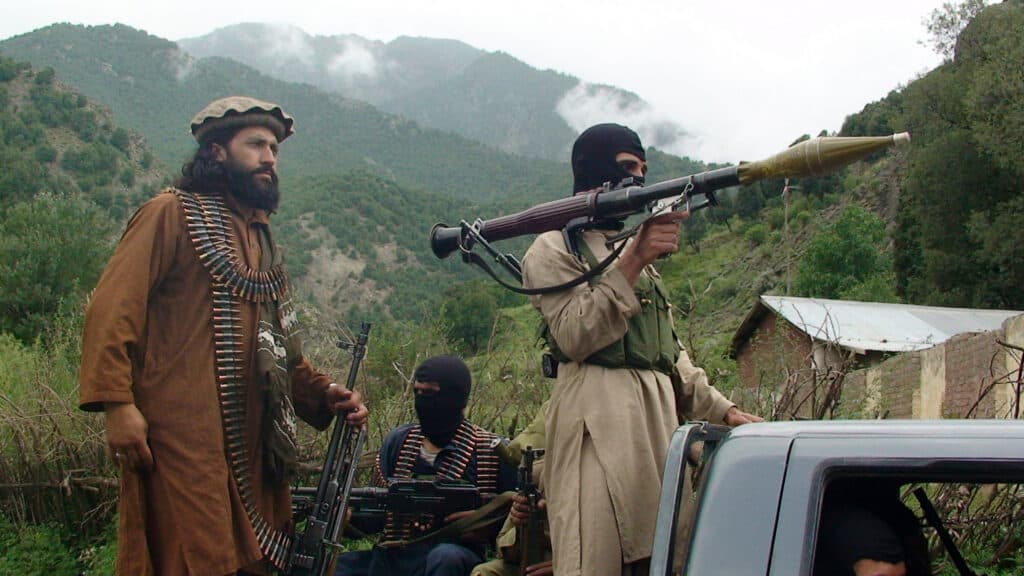
In this Aug. 5, 2012, file photo, Pakistani Taliban patrol in their stronghold of Shawal in the Pakistani tribal region of South Waziristan. Five years after setting up an umbrella organization to unite a violent symphony of militant groups operating in Pakistan’s tribal regions, the Pakistani Taliban is fractured, strapped for cash, and losing the support of a local population that is frustrated by a protracted war that has forced thousands out of their homes, say analysts and residents of the area. Ishtiaq Mahsud/ AP File Photo
Also known as the Pakistani Taliban, correct?
Yes, that’s correct. The Pakistani Taliban emerged in 2007, and since the Taliban’s return to power here in Afghanistan, they have seen a huge surge in Pakistan, and the violence levels in Pakistan have spiraled and increased exponentially. Pakistan’s argument is that the TTP has sanctuaries in Afghanistan, that most of their leadership and some of the membership is based in Pakistan, and they are carrying out cross-border incursions into Pakistan to carry out violence. Afghanistan’s argument, on the other hand, is that the TTP is an internal Pakistani security issue, that there are very few, if any, TTP present here in the country, and that it’s the responsibility of Pakistan to prevent cross-border incursions while Afghanistan is willing to offer assistance for it, it’s a porous border that they cannot control themselves, as well.
So, just to give a little recap here: Basically, Pakistan says that Afghanistan is helping this insurgent group in Pakistan called the Pakistani Taliban. Kabul, led by the Taliban government in Afghanistan, denies it and says this is an internal security issue for you. Where does the truth lie between those two statements?
It’s an incredibly complicated situation. Pakistan initially did not actually accuse Kabul of supporting the TTP. What they wanted the Taliban to do was crack down on the TTP. And Kabul has always resisted that call and has said that “we will not embroil ourselves in other people’s fights” and has always framed this as a domestic Pakistani battle that Pakistan needs to resolve with its own population.
In terms of the cross-border nature, it’s worth recalling this as the huge disputed border [which is some 1,600 miles long]. And armed groups on both sides of the country have always been able to utilize that in order to operate. And it’s been an incredibly difficult border for anyone to control, including the NATO-led international forces that operated in Afghanistan for two decades.
I would say that the TTP definitely is able to instrumentalize that border and has been able [to] come into Afghanistan and cross into Pakistan. But as Pakistan’s frustration has grown, I think the accusations have become much more pointed. As you pointed out, rightly, Pakistan has more recently begun to accuse Kabul of not only tolerating the TTP, but also supporting it. And [Pakistan] also, more recently, even accused the Taliban of supporting Baloch separatists, the Balochistan Liberation Army, which primarily operates in southern Pakistan and Balochistan province.
A whole different area of conflict.
Exactly, and recently, senior Pakistani politicians have even called the Taliban a proxy of India. So, as frustration over the TTP has grown, I think the issue has metamorphosed into where I think distrust has grown quite significantly, and the prospects of bridging the two sides has become much more difficult.
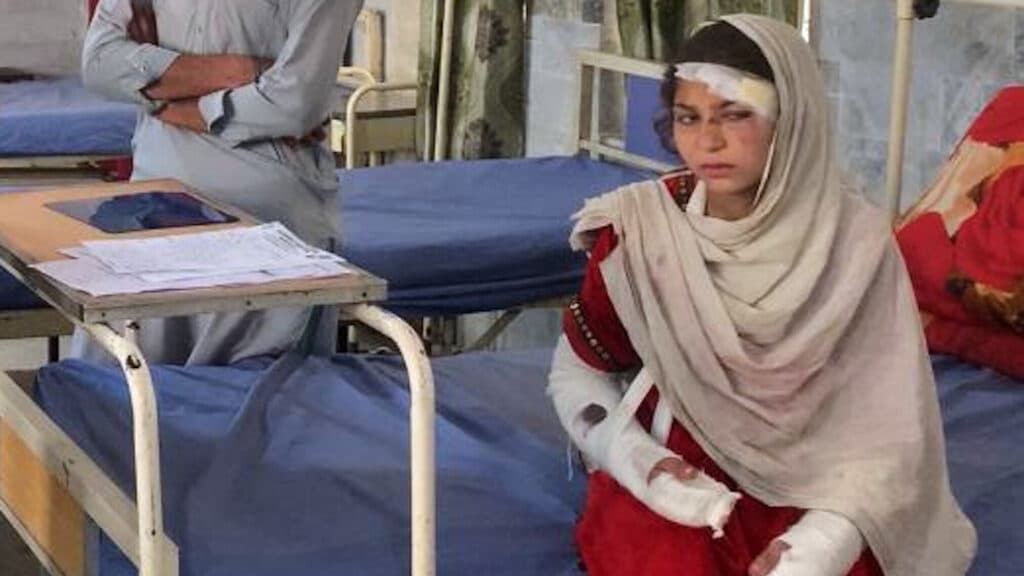
A girl, who was injured in the overnight cross border fighting between Pakistan and Afghan forces, receives treatment at a hospital at Khar, in Bajaur, a district of Pakistan’s Khyber Pakhtunkhwa province bordering with Afghanistan, Feb. 27, 2026. AP Photo
Are these attacks that happened overnight an escalation or just a continuation of this tit for tat?
So, I think we’ve gotten a couple of important precedents. Firstly, Pakistan has made it quite clear that every time there’s a serious security incident inside Pakistan by the TTP or other militants in the Khyber Pakhtunkhwa province, they will retaliate by striking targets inside Afghanistan. Usually, Pakistan says they’ve targeted TTP, or ISKP, or other militants, and Afghanistan denies it, saying civilians have been targeted. The second precedent is [that the] Taliban have now established a precedent where they respond to these airstrikes by carrying out attacks across the border. When that happens, Pakistan, at times, has felt that it needs to respond by carrying airstrikes on Kabul. And the rhetoric from the Afghan side, again, is to ratchet up and up the ante and try to do something more. So again, I think the challenge really is we’re setting a precedent when neither side really knows how to back down from that and de-escalate.
So, how much significance should we read into this comment on Twitter from Pakistan’s defense minister that this is now open war? Is that a significant statement?
It’s worth pointing out that the rhetoric on both sides has become quite polarizing, particularly since October last year. The Pakistani defense minister has made similar comments, accusing the Taliban of being Indian proxies and whatnot. It’s interesting because the Pakistani media now almost unanimously calls the Taliban “a Taliban regime” and the language is not more. And there’s even talk of regime change in some Pakistani media circles. On the Afghan side, similarly, the rhetoric has become much more hardened. The Pakistani government is often referred to as “the military regime.” The language is that the Pakistani military is trying to deflect from its own failures and its own troubles with, for example, Imran Khan’s PTI party by trying to scapegoat Afghanistan. So, the rhetoric has become much more polarizing and much more antagonizing in a sense. But my hope is that saner minds are able to prevail. And despite the rhetoric, that at least when it comes to action, that we will not see a significant escalation.
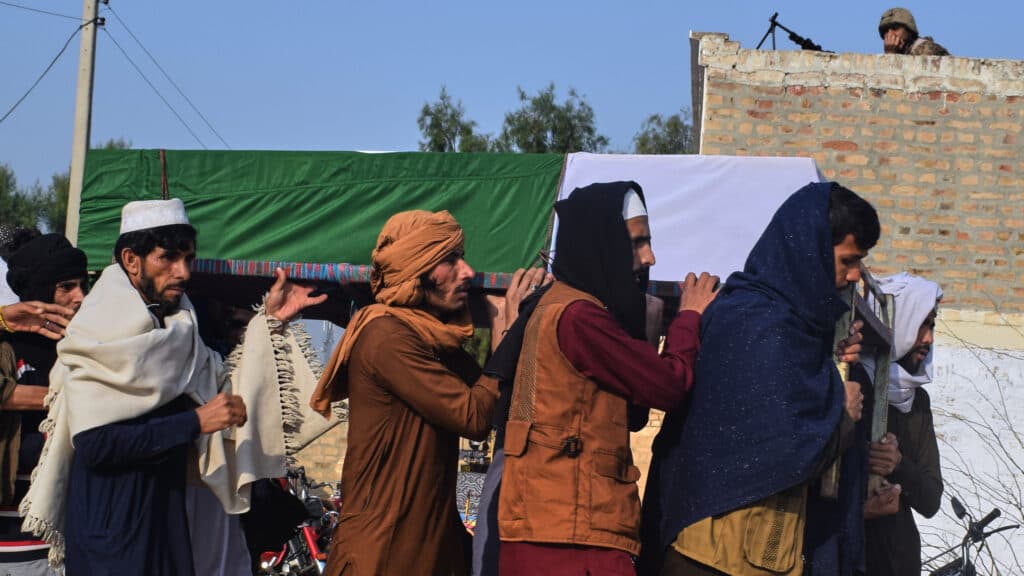
An army soldier keeps position on a rooftop as people carry the coffin of an army soldier, killed in the cross-border clashes of Pakistan and Afghan forces, for his funeral prayer at a village in Lakki Marwat, a district of Pakistan’s Khyber Pakhtunkhwa province, Feb. 28, 2026. G.A. Marwat/AP Photo
Given all this back and forth, though, it sounds like a tense time to be in Kabul. What does it feel like on the ground there today?
While many Afghans might not be happy with the Taliban’s control of the country, I think many appreciate the peace that the country is enjoying.
Interesting dichotomy there.
Exactly. And the worry for many Afghans would be [that] it almost feels surreal for many Afghans who have gone through nearly five decades of conflict, right? So, I think the worry really in here, not only in Kabul, but across the country, is that we are again towards the path, towards a new set of conflicts that would open another Pandora’s box for the country.
Parts of this interview have been lightly edited for length and clarity.