PRX is a 501(c)(3) organization recognized by the IRS: #263347402.
Health aid pact between US and Zimbabwe collapses
An agreement between the US and Zimbabwe, under which the US would send health aid directly to the country, has collapsed. The Zimbabwean government rejected the deal over concerns about data sharing and sovereignty. The World’s Host Carolyn Beeler speaks with Stephen Morrison of the Center for Strategic and International Studies.
Sibusisiwe Ngalombi, 42, who is a community health worker, shows a USAID jacket she used to wear in Harare, Zimbabwe, Feb. 7, 2025.
Aaron Ufumeli/AP Photo
After negotiations around a funding agreement worth more than $360 million collapsed, the United States has said it will wind down health aid to Zimbabwe. Previously, USAID was the US government institution that provided financial assistance to Zimbabwe. However, after that agency was shuttered last year, money provided to the African nation’s government through this bilateral agreement was expected to replace some of the aid that had previously flowed through USAID.
The Zimbabwean government rejected the deal partly because of requirements to share health data, and several other African nations are also reviewing their new aid agreements with the US.
To better understand this, The World’s Host Carolyn Beeler spoke with Stephen Morrison, director of the Global Health Policy Center at the Center for Security and International Studies, about this strategy.
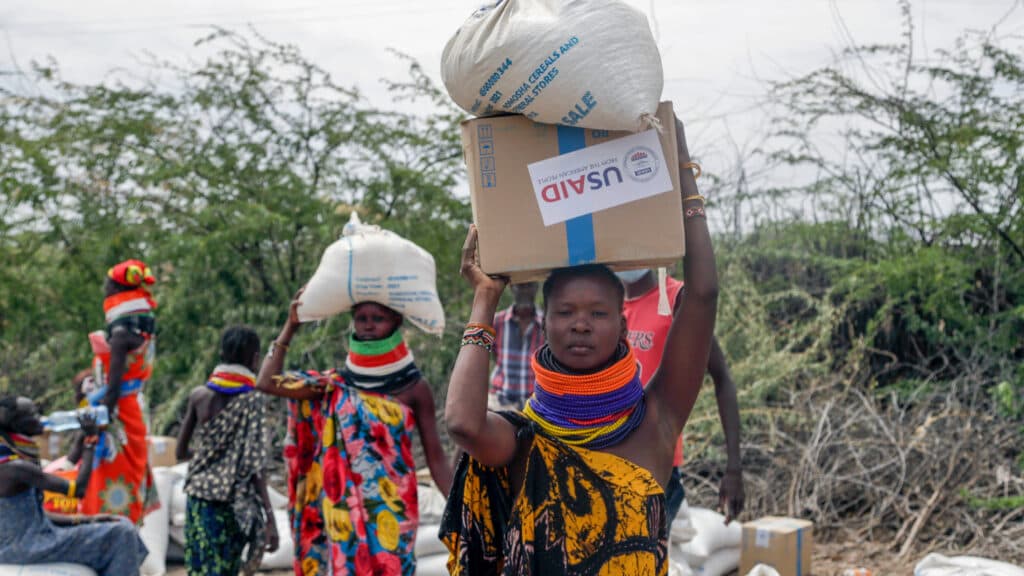
Locals residents carry a boxes and sacks of food distributed by the United States Agency for International Development (USAID), in Kachoda, Turkana area, northern Kenya, July 23, 2022.Desmond Tiro/Ap File Photo
Carolyn Beeler: What is it about these agreements that a growing number of African nations are objecting to?
Stephen Morrison:Apparently, there are conditions included in these agreements that call for the sharing of data and the sharing of specimens, as well as, reportedly, other transactional agreements which may be with respect to access to critical minerals and the like, and it’s touching on issues of sovereignty.
I do want to drill into the Zimbabwe case just so we can look at this as an example. The Zimbabwean government took issue with specific conditions about data sharing in the agreement, according to statements from a government representative, and also sharing of specimens of pathogens. Can you tell me any more about that and what Zimbabwe’s concerns were there?
Well, on data, it’s privacy. And the pattern has been to rely heavily upon international NGO implementers that have controlled the data and have controlled the standardization and collection of data. That era is ending and responsibility for standardizing and ensuring quality, collection and protection of data is shifting to the partner countries. One of the big open questions is, “Are we going to enter a period where there is less standardization and more uncertainty about quality and protection of data?”
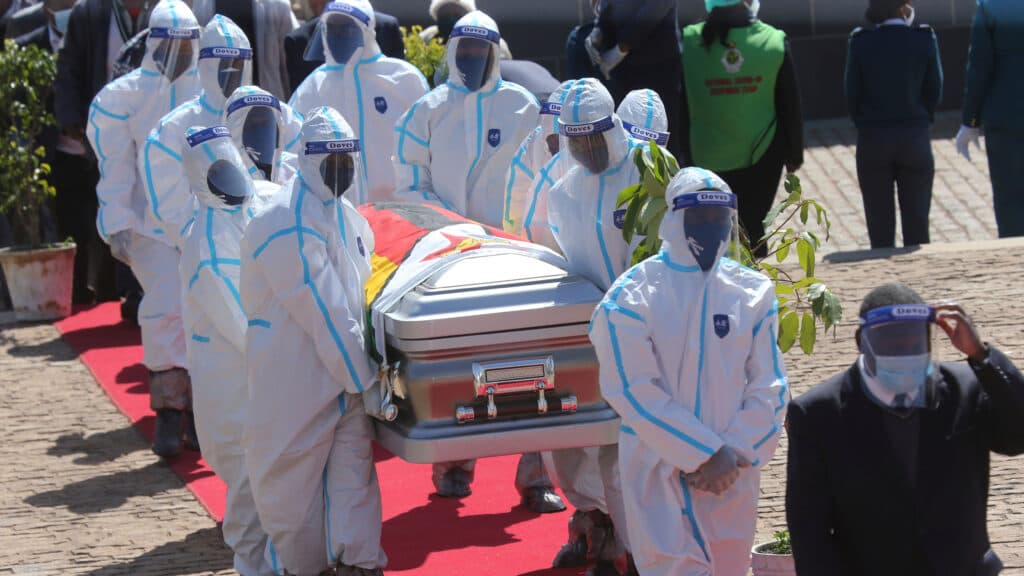
Health officials carry the coffin of Zimbabwean minister Perence Shiri, who died of Covid-19, during his burial in Harare, July, 31, 2020. Zimbabwes capital, Harare, was deserted on Friday, as security agents vigorously enforced the country’s lockdown amidst planned protests. Tsvangirayi Mukwazhi/AP File Photo
So, for example, if all the data about how viruses are spreading right now does not go through the WHO but is held by specific countries like the US when they give money to a specific country, what are the implications of that?
Right. Some of the data we’re talking about is surveillance systems. The sharing of pathogenic samples is with respect to [when] you have an outbreak, you need to investigate the genetic makeup and quickly move towards the kinds of tests, the diagnostics, the therapies and vaccines required to bring those under control. But the sovereign concerns of a country like Zimbabwe is, “what guarantee is there to have affordable access to those tools?” These are valid and legitimate concerns, and they stem from the terrible experience that African states had during COVID-19, which brought forward very dramatically that low-income countries — African and others, or middle-income countries in the case of South Africa or Zimbabwe — were at the back of the queue.
When it came to vaccines?
With respect to vaccines and other critical inputs, and they paid a huge price for that.
What is at stake on the ground for people who previously did benefit from USAID dollars helping provide care for things like HIV treatment, etc? What’s at stake for people in Zimbabwe?
Well, so the Zimbabwe government, in taking a strong stand of this kind, if it results in a permanent rupture, it has grave consequences for its own population. It would be a tragedy. Neither Zimbabwe nor the United States can afford to have this rupture happen and be permanent.
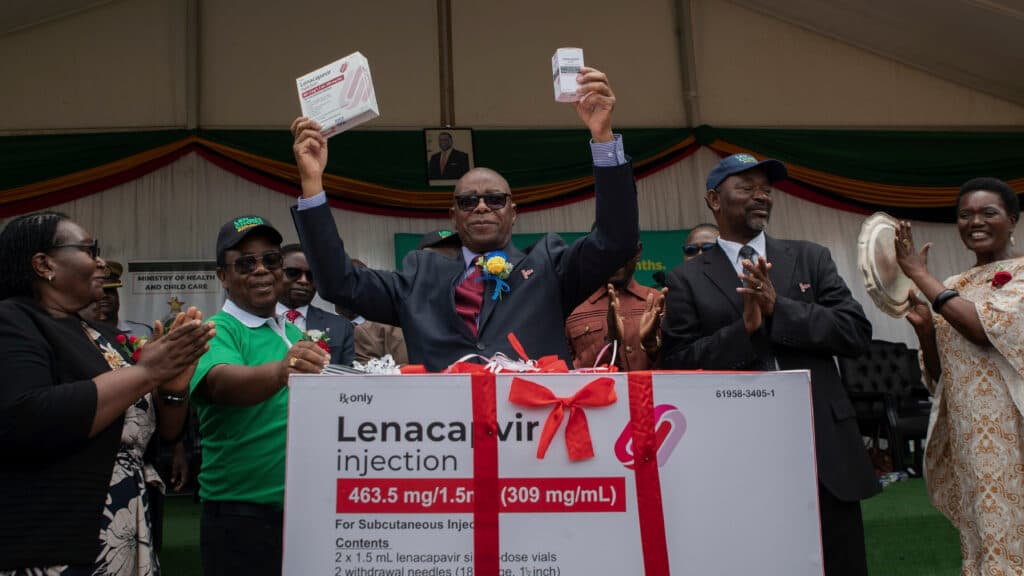
Zimbabwe’s Minister of Health and Child Care Douglas Mombeshora holds up containers of lenacapavir, a new HIV prevention drug, during its launch in Harare, Zimbabwe, Feb. 19, 2026. Aaron Ufumeli/AP Photo
This is being seen as a more transactional approach to providing health aid. Is there a precedent for the US using health aid money as leverage in other types of deals?
This has not been the pattern. This is a new dimension of conditionalities that applies to other sectors, whether tied to critical minerals.
Yes. You know, this is a transactional doctrine. If you read the America First Global Health Strategy, this is an administration that has laid this out.
I want to ask about historical precedents, though, because I’ve been reading that the Biden administration did sign bilateral deals with some 50 countries, including some in Africa as part of this deal in biosecurity, so they got pathogens in return for this aid. So, is this substantially different than things the US has done in the past?
Well, the agreements concluded under the Biden administration were part of its global health security strategy. And that was not a transactional strategy. It was one that was calling for sharing of data, but it was investing in capabilities in health security.
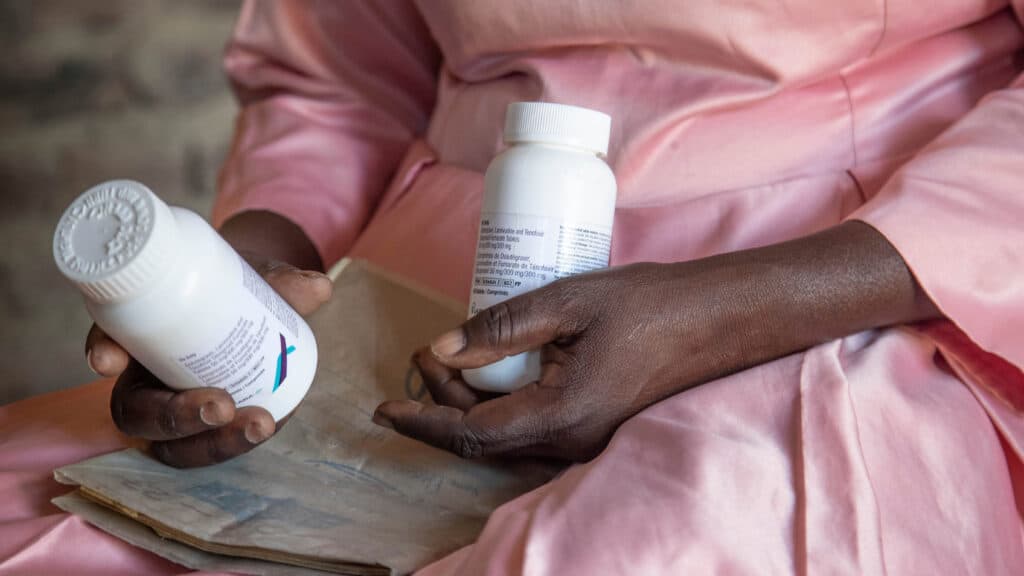
Florence Makumene holds HIV medication that she received through funding from the U.S. President’s Emergency Plan for AIDS Relief (PEPFAR), along with her hospital records book, at her home in Harare, Zimbabwe, Feb. 7, 2025. Aaron Ufumeli, AP File Photo
So, this seems different on balance to you?
When we say transactional here, I’m assuming, and again, it’s difficult to know exactly because we don’t have the exact terms of what’s in these agreements that are now being scrutinized.
So, there’s limitations to what we can know. We’ve talked about how the criticisms or the concerns that Zimbabwe, for example, have here are valid about sharing data and pathogen samples. But you also mentioned how some of the goals of this new strategy from the Trump administration aim to improve basically self-sufficiency and governments building up their own capacities. Could there be upsides to this approach?
Certainly, I mean, the reform measures at the heart of this strategy are ones that have been applauded by African governments, who looked at this acute dependence on the United States and thought, “This is dangerous!” So, I think we should be hopeful that there can be progress and that this model can work.
Parts of this interview have been lightly edited for length and clarity.