PRX is a 501(c)(3) organization recognized by the IRS: #263347402.
A discussion about Denmark’s forced IUD program for Greenlandic Inuit women and girls
The World’s Host Carolyn Beeler speaks with Victoria Pihl Sørensen, a Danish historian who has studied Denmark’s IUD program in Greenland, to understand how the policy took shape and the impacts on an entire generation of Indigenous people.
In this file photo, a woman walks near a church in Nuuk, Greenland, March 7, 2025.
Evgeniy Maloletka/AP/File photo
The United States marks Indigenous Peoples’ Day on Monday. It was first formally commemorated by President Joe Biden in 2021 to honor Native Americans as a counter-celebration to the federal Columbus Day holiday.
Indigenous peoples have often faced colonization, displacement and other forms of oppression around the globe. Late last month, Denmark issued an official apology for forcing Indigenous women and girls from Greenland into using long-lasting contraceptive devices.
At a ceremony in Greenland’s capital Nuuk, some of the women in attendance wiped away tears as the Danish Prime Minister Mette Frederiksen said that the use of birth control without consent and birth control intended for adult women but used on children’s bodies was wrong.
Starting in the 1960s, Danish doctors inserted IUDs (intrauterine devices) into thousands of Inuit women and school-age girls, often without their or their parents’ knowledge or consent. Advocates and victims of that policy have sought justice for years.
The World’s Host Carolyn Beeler spoke with Victoria Pihl Sørensen, a Danish historian who has studied Denmark’s IUD program in Greenland. She is now a professor at the University of Colorado, Boulder. She said that to understand how a policy like this took shape, it is important to look first at how Denmark annexed Greenland in the 1950s.
“The Danish narrative was that Greenland now would become a part of Denmark on so-called equal footing,” Sørensen said. “This meant that Denmark obligated itself to offering new social services, education, health care and infrastructure in Greenland on par with Danish structures, at least in theory.”
But in reality, Sørensen added that Denmark’s colonial attitude toward Greenland continued. And the cost of providing those equal social services to the territory fueled the idea behind the forced contraception policy.
“You can imagine that the more people you have to service in Greenland, the more expensive it would get, or so they imagined,” she said. “And so, it’s in this context and from this mindset, this concern, that the Danish idea of limiting the Greenlandic Inuit fertility rate emerges.”
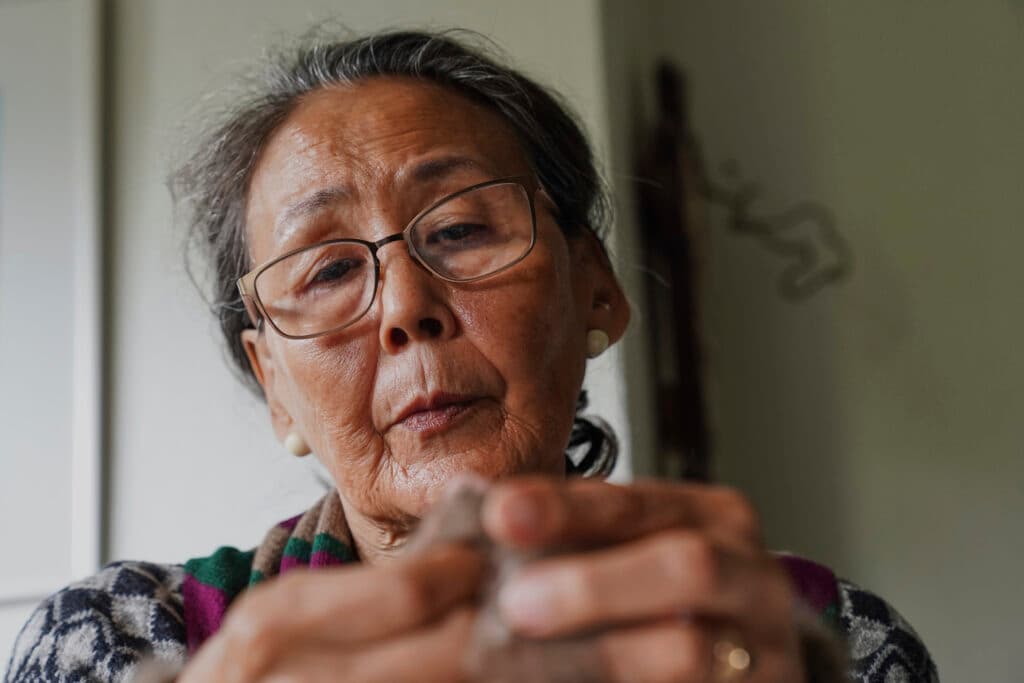
Kirstine Berthelsen, a 66-year-old retiree, prepares wool for sewing at her home in northern Copenhagen, Denmark, Sept. 17, 2025. She believes she was 14 when she was fitted with an IUD in Greenland.James Brooks/AP/File photo
Carolyn Beeler: What was the stated rationale by the Danish health authorities at the time?
Victoria Pihl Sørensen: The rationale was that the population was rising too fast in Greenland at the time and that it needed to be stopped.
And who was targeted with these interventions and why?
So, the IUD program was launched in Greenland as a state-sponsored population control program in 1965. Leading doctors from the Danish Mother’s Aid institution, which was a state-run institution, traveled to Greenland in 1965 and distributed and fitted IUDs on thousands of Inuit girls and women to limit the Inuit population.
In some cases, I understand, that this was coercive or people were pressured, and in some cases it was actually done without prior knowledge or consent of either the kids or the parentst?
That is right. Testimonies by women today attest to the fact that often what happened was that they were led directly from their classrooms by their teachers to a room in which a doctor would wait to fit them with an IUD. This means, of course, firstly, that often parents were not consulted and consent was not given. But it also means that you’re in a situation where you have an Inuit girl, a child, who is standing in front of usually an adult White and most often male Danish doctor in a space where she does not know what is going on and the power imbalance is completely skewed.
So, that’s part of what we think about when we think about the concept of consent in this situation. There’s also evidence from testimonies that the women, they explained that they were not told what was happening to them, and many of them did not even know what this procedure meant for them. There’s testimonies that show that some women didn’t even know what had happened to them and found out later in life that they had been fitted with an IUD when they started experiencing complications when they were trying to have children.
And obviously the contraceptive effects, if you have not consented to that, are incredibly serious. But even just getting an IUD inserted is painful even for adults.
Yes.
And it is a very intimate situation that you can imagine would be very traumatizing to a kid who doesn’t know what’s going on.
Absolutely. IUD is a contraceptive device that is a foreign object, usually made of copper or plastic, and it’s inserted into the uterus to prevent pregnancy. The one that was used by Danish authorities in Greenland was made of plastic. It was T-shaped. It was relatively large. It was a recently developed model that was rolled out quickly without really testing the impacts of it on girls and women. And in fact, doctors recommended at the time, and the developers of the technology recommended, that it only be inserted into the uteri of women who had already given birth. If you have not given birth, there’s a higher risk of complications and infertility and pain.
And some of the girls who had these inserted were as young as 12 years old, right?
That’s right. Some were as young as 12, even though the official reports or the news reports that we’ve been able to find mention the cut-off age as being 15, there’s testimonies that show, and the newly released report from the Danish government shows, that girls as young as 12 had IUDs inserted, yes.
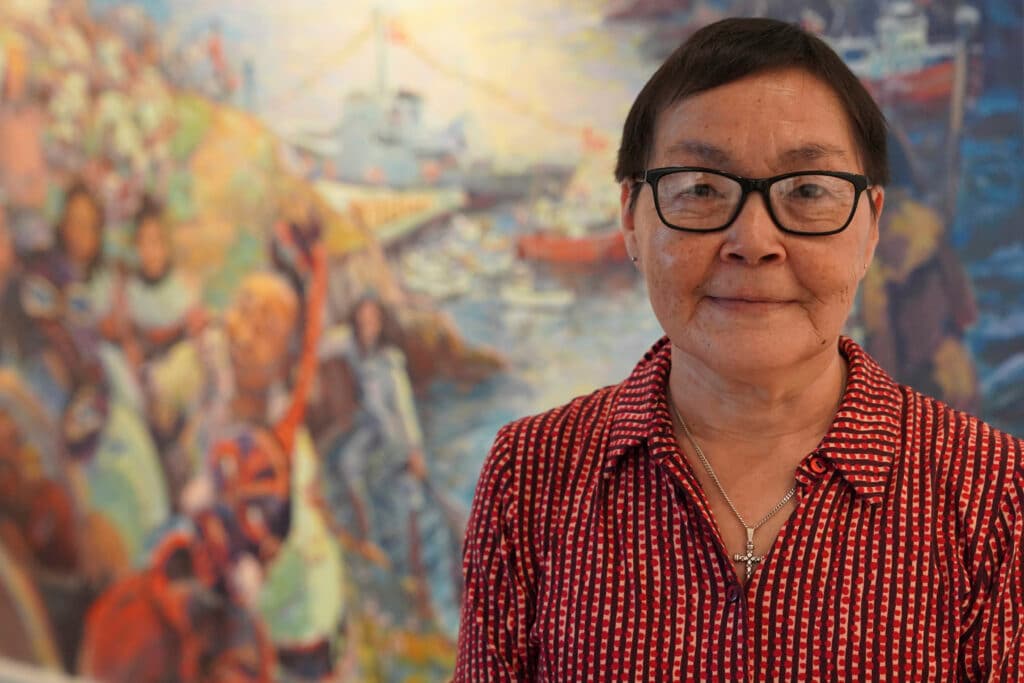
Katrine Petersen, a 52-year-old retiree, poses for a photo in front of a painting at The Greenlandic House in central Copenhagen, Denmark, Sept. 19, 2025. At age 13, she was fitted with a contraceptive device by Danish doctors without her consent.James Brooks/AP/File photo
Those are news reports published around the time that this was happening, you’re saying, that gave the older age?
Correct. So, one of the things that my colleagues, Naja Dyrendom Graugaard and Josefine Lee Stage, who I’ve done research with about this history, and I have been calling attention to in our research is the fact that while there might be a popular narrative in the Danish public today that the IUD program was something that happened in the dead of night, away from public view, that it was secret and obscure.
You can go back and you can look at contemporaneous news publications in the ’60s and in the ’70s, and you can see that the IUD program in Greenland was widely discussed, frequently discussed and also celebrated with sensational headlines that I would say made light of Inuit Greenlandic reproductive life.
One headline that I have for you from 1967 exclaims, “Greenland to be spiralized!” With an exclamation mark, where “spiralized” refers to the conventional coil shape of an IUD, although the one that was in fact used in this program was T-shaped. But in other words, this wasn’t a secret endeavor.
Yeah, so the spiral is another name for the IUD and they were using it in a very lighthearted way in that headline.
Yes.
So, those reports, those headlines, were in media in Denmark, not in Greenland. So, the result was that people in Denmark knew about and celebrated this forced contraception, while in Greenland the women and girls experiencing it didn’t understand what was being done to them.
That is the correct characterization, although I should say that the IUD program was also reported about in Greenlandic newspapers. Now, that of course, we cannot conclude that this means that the girls and the women who it happened to even knew what it was about when they were subjected to this practice.
I’m curious what the doctors who were part of this program thought of it. Do we know how they explained their participation or what potential benefit they might have seen from this program?
I’ve looked at as many reports as I have been able to find. And I think that they had an idea that they were doing the right thing and that they were doing something progressive and needed. The Danish doctor who led the IUD project in Greenland was actually working in collaboration with an American organization called the Population Council, which was funded by the Rockefeller Foundation.
And they were very concerned with what they called global overpopulation. And in that realm of things, in that organization, and for overpopulation advocates, Greenland and the work that the Danish doctors did in Greenland with the IUD, became a celebrated success story of how you might handle so called overpopulation.
What about the lifelong repercussions those women faced?
That’s an extremely important issue, and I can’t speak for the women, then girls, who were subjective to IUD abuse. And I cannot and I won’t speak for the Greenlandic Inuit community. But when you listen to the women who have spoken out, you will hear them recount experiencing pain, infertility, shame, confusion and lifelong trauma as a result of their coerced inclusion in the IUD program. And if we think about it in a sort of even larger picture, and we look simply at the population statistics, we can see that from 1965 to 1973, so in less than eight years, the birth rate in Greenland was cut down more than half.
Wow. And that was around the time period that this program was at its largest, right, the insertion of these IUDs?
That’s right. So, the most intense period of the program you might date to between 1965 and 1970. During that time, my colleagues and I, we have estimated that 3,821 women of the ages between 14 and 39, or what amounts to 56% of Greenlandic Inuit women in this age range, they had gotten an IUD. In less than five years, about half of the women and girls in this age range had gotten an IUD.
And so, there were population-wide impacts of that.
There were, and like I said, we can see that the [number of] children born fell 50%, and we can only speculate about the detrimental effects that such an extreme mechanism of population control has had for national economic self-sufficiency in Greenland, for example, and also for the fight for independence in Greenland. Because as Naja Dyrendom Graugaard and Josefine Lee Stage and I argue, what you’re potentially looking at here is you’re looking at the loss of a generation of Indigenous Greenlandic Inuit children.
Today, for context, the population of Greenland is only about 56,000 people. So, that number of almost 4,000 IUDs back in the ’60s and ’70s is a large chunk of that, or a significant chunk of that.
It’s very significant.
This policy didn’t entirely end until the 1990s, right?
That’s right. While you might technically date the program itself as we talk about it and how it was launched in ’35, you might technically date it to have ended formally in ’75. There were unethical, manipulative and coercive practices of IUD insertion that continued well into the late 20th century in Denmark. So, there are women who have come forward and who have recounted stories of being involuntarily fitted with an IUD up into the ’90s. And I would say just to add to that, the Danish administration of the health care system in Greenland ends in ’92, and then in ’92, it is the Greenlandic government that takes over the administration of the health care system. So, these women are recounting that this practice has continued and bled into the Greenlandic home rules administration of the health care system.
I understand there is currently a lawsuit being brought by women who had these IUDs inserted. What are they asking for?
They are asking the Danish government to recognize that their human rights have been breached as a result of this IUD practice and they are asking for reparations. My understanding is that the amount that they are currently seeking is $43 million Danish kroner in reparations.
That’s about $6.5 million they’re asking for. Did the Danish prime minister offer anything beyond words in her apology? Was there any talk of financial compensation?
Yes. So, after years of pressure by the women and their allies, the Danish Prime Minister Mette Frederiksen finally announced that Denmark will pay some form of reparations, although it remains to be seen how much. And there are Greenlandic Inuit people and politicians who are currently asking for the reparative work that this apology will require. They’re asking for monetary compensation, for access to psychologists and counseling and so on. So in other words, it’s not generally seen as enough to apologize, but this apology is the beginning of a long process of necessary reparative work, and it’s uncertain how Mette Frederiksen and the Danish government will decide to take on and carry out this responsibility.
I know that you, yourself, are Danish but I wonder how you’ve seen this being discussed by the women who were impacted by this policy.
I have seen that it is significant but it has come several years after the women came forward with their stories. Since the IUD program began in the ’60s, these women have already been waiting a long time. And with the years that have passed since this history entered the Danish media landscape, they’ve been made to wait even longer. Now, this doesn’t mean that the apology is not seen as significant. It is. And in fact, as the forewoman of the group of women who have been impacted, Naja Lyberth, proclaimed in the Greenlandic Inuit news media KNR, and I quote, that “their fight and resistance has borne fruit.” So, it is significant. Now what remains to be seen is what will materialize of it in terms of actual material support and reparations.
This interview has been lightly edited and condensed for clarity.