Public radio’s longest-running daily global news program.
©2026 The World from PRX
PRX is a 501(c)(3) organization recognized by the IRS: #263347402.

Colectivos — armed civilian groups with roots in guerrilla movements — insist they are educators and patriots. But in recent years, many have functioned as armed enforcers for the state. Analysts warn their future could determine whether the country stabilizes or slips into chaos.
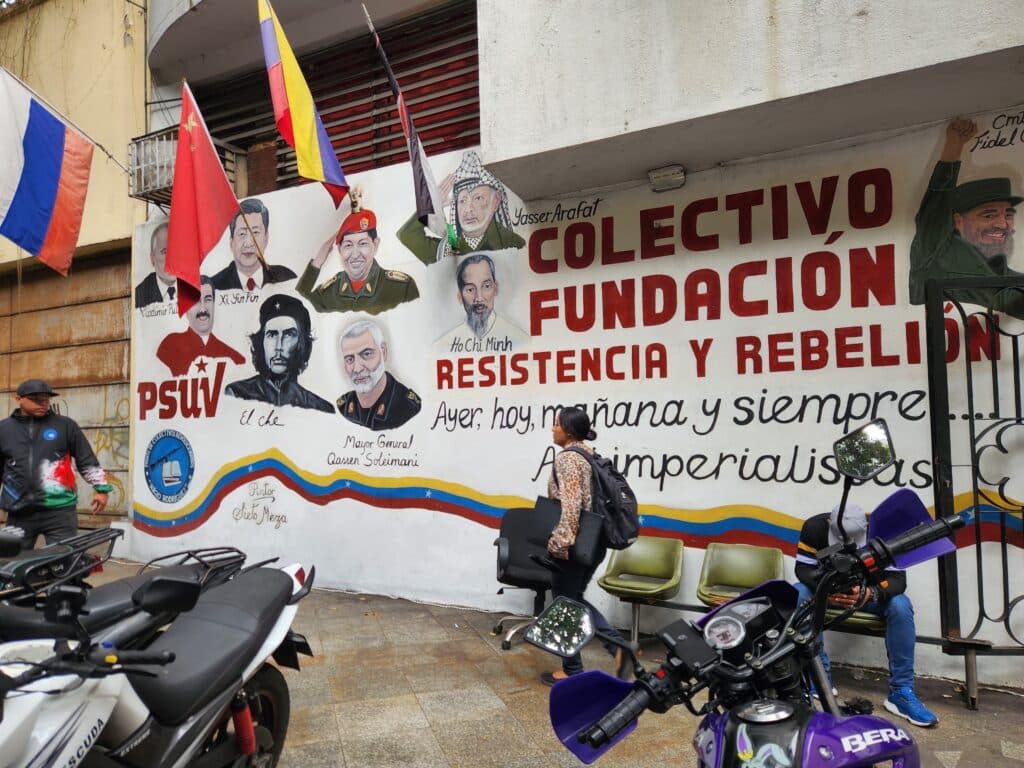
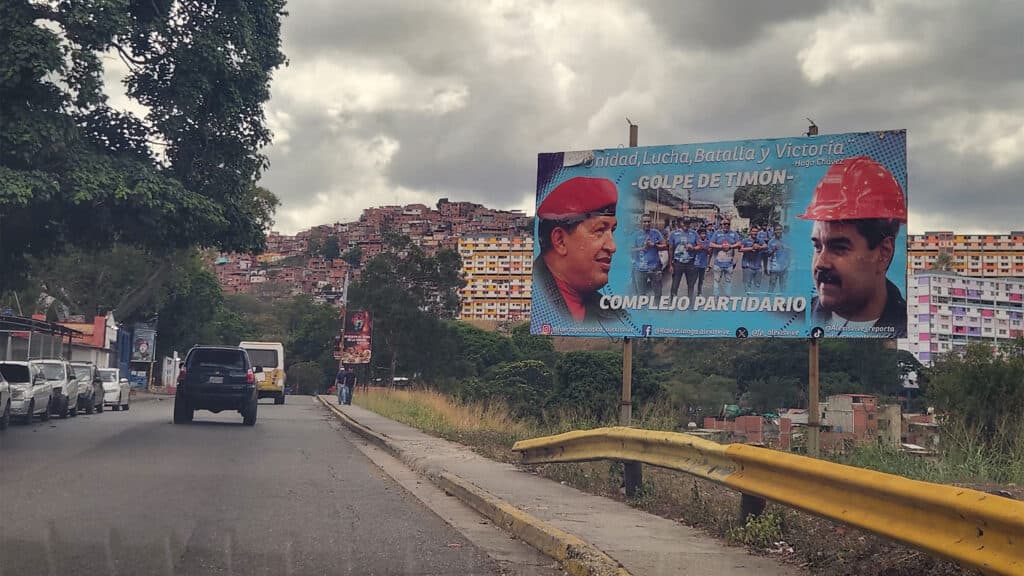
Political murals in Caracas reflect the legacy of Venezuela’s socialist movement.
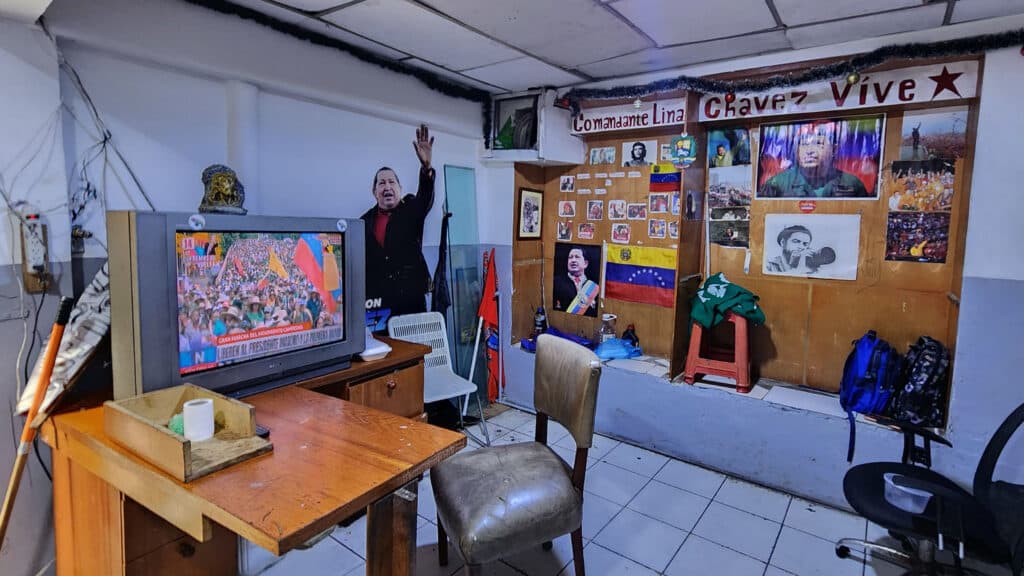
On a busy afternoon in downtown Caracas, among government ministries and faded political murals, a smaller building stands out. Its exterior walls are painted with images of Hugo Chávez, the late president whose socialist movement still shapes Venezuela’s politics. Inside, a narrow hallway hums with the sound of state television. Upstairs, behind a desk on the second floor, a man who calls himself Comandante Navas waits to receive visitors.
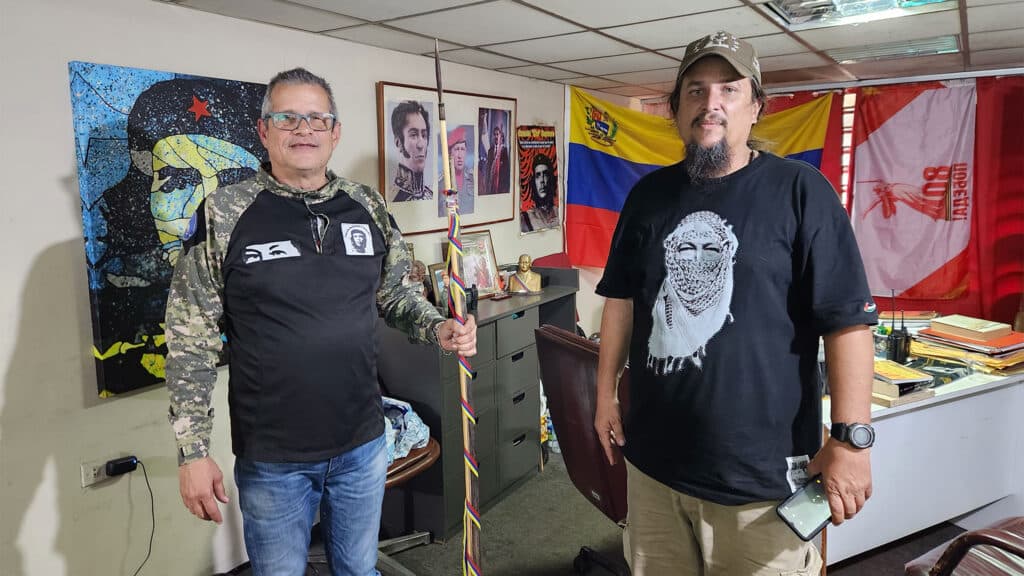
“My name is Jorge Navas,” he said, introducing himself as the head of a colectivo called Resistencia y Rebelión — Resistance and Rebellion — part of a larger network of revolutionary groups.
The office doubles as a political shrine. A large portrait of the revolutionary figure Che Guevara hangs on one wall. Nearby are images of Chávez, ousted President Nicolás Maduro and independence hero Simón Bolívar. Stacks of books line a table — about Vladimir Lenin, revolutionary pamphlets, political theory.
“I believe in literature,” Navas said. “Literature shapes you. If you don’t read, you’re vulnerable.”
For Navas, colectivos are about political formation and community work — teaching history, organizing workshops, defending what he calls Venezuela’s sovereignty.
But outside this office, the word “colectivo” carries a far more controversial meaning — referring to armed pro-government groups accused of intimidating opponents and enforcing loyalty in some neighborhoods.
Their role takes on new weight at a moment of political uncertainty. US President Donald Trump has said he expects the United States to “run” Venezuela for years during a recovery period. But governing the country will not be simple.
Venezuela, home to about 30 million people, is crowded with armed groups tied to illicit economies — from Colombian guerrillas along the border to criminal networks controlling illegal gold mines in the south. In Caracas, colectivos are among the most visible of these actors.
Navas’s own political journey began decades ago. He said he was drawn into activism by reading about the World Wars and the rise of communist movements — and what he described as Western attacks on the left. He later traveled abroad, he said, to Lebanon, El Salvador and Nicaragua, where he trained alongside left-wing movements and learned what he calls armed struggle.
“We’ve always practiced the handling and knowledge of weapons,” he said. “I am a militant.”
He rejected the idea that colectivos are criminal organizations.
“That narrative that we are criminals, kidnappers or human rights violators — that’s completely false,” he said. “We are defenders of sovereignty and independence.”
“The homeland runs in our blood,” he added.
Researchers who have studied colectivos for years describe a more complicated evolution.
Roberto Briceño, a criminologist at Venezuela’s Central University who has interviewed colectivo leaders across the country, said the groups existed before Chávez came to power in 1999 and were already armed in some cases. But once Chávez became president, Briceño said, he moved to incorporate them into his political project.
“Chávez decided he wanted to co-opt them,” Briceño said. “To finance them strongly.”
According to Briceño, the government did not create the colectivos or directly arm them, but it embraced them — funding community media outlets, donating buildings, allowing them to control territory and, crucially, permitting them to operate with broad impunity.
“They were useful,” Briceño said. “When there were protests, they did the dirty work of the police.”
Over time, he argued, that protection blurred boundaries. Some colectivos drifted into criminal activities — from extortion to controlling fuel lines and distributing subsidized food packages. Others maintained a more ideological character. The line between political activism and criminal enterprise became difficult to trace.
Phil Gunson, a senior analyst with the International Crisis Group based in Caracas, said the relationship between the state and colectivos evolved gradually but significantly.
“It’s very convenient for governments who want to intimidate their opponents to have civilian enforcers who can instill fear,” he said.
Gunson argued that once groups are armed and shielded from prosecution, incentives change. “People with guns who know they’re not going to be prosecuted will inevitably turn to crime,” he said.
Many colectivos, he added, began as neighborhood political organizations with ideological roots in leftist guerrilla movements. Under Chávez and later Maduro, some became armed motorcycle groups used to intimidate protesters and voters — giving authorities plausible deniability while exerting control on the streets.
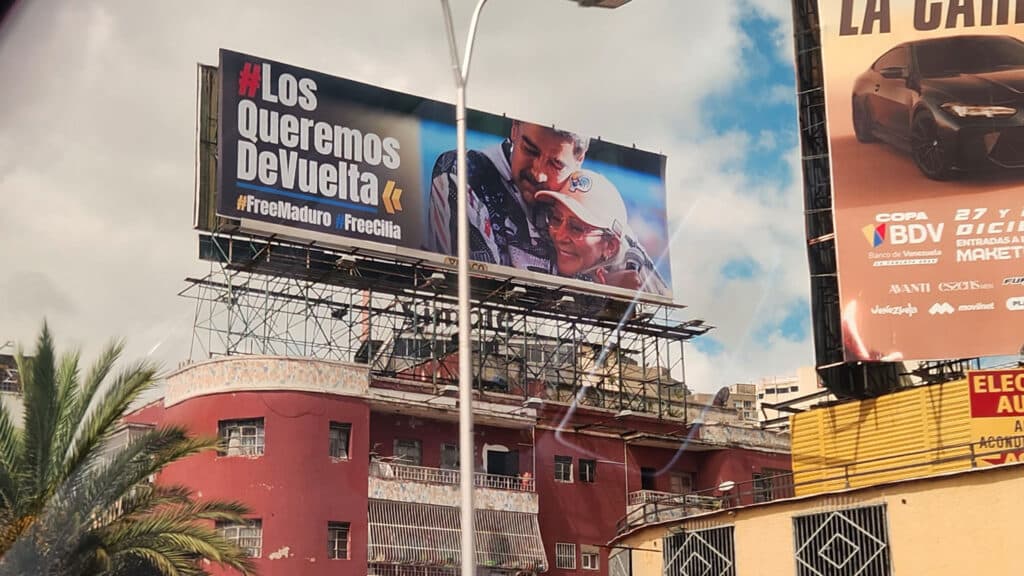
The capture of Maduro has introduced new uncertainty. As Venezuela’s government begins responding to pressure from Washington, Navas shared his views on the moment.
He said officials are simply buying time — adapting so they do not break. The revolution, he insisted, is not over.
Another colectivo member, Alejandro Coito, was more defiant.
“Our president is a prisoner of war,” he said. “There are not two presidents. Return our president.”
He argued there should be no elections until Maduro returns and described the government’s dealings with the United States as tactical — a way to gain time.
What happens to colectivos in a political transition remains one of Venezuela’s most delicate questions.
Gunson warns that armed groups cut off from state backing could retreat into dense urban neighborhoods, much like criminal gangs that dominate parts of Brazil’s favelas. A government seeking to reassert control could face prolonged low-level conflict, targeted violence or territorial standoffs.
Briceño sees another possibility. If state funding dries up and democratic space opens, he said, some colectivos could fade. Others might attempt to reinvent themselves through formal politics — forming parties, competing for local office, seeking legitimacy through elections rather than force.
But not all would disarm easily. Decades of ideological formation, territorial control and access to weapons are not undone overnight.
And colectivos are only part of Venezuela’s broader armed landscape, alongside guerrilla groups, mining syndicates and criminal networks whose next moves could shape the country’s fragile future.
For now, inside that small building in downtown Caracas, Navas insists his group is about books, history and sovereignty. But as Venezuela enters an uncertain transition, what colectivos become next — political actors, criminal networks or something in between — may help determine whether the road ahead leads toward stability or something far more chaotic.
