Public radio’s longest-running daily global news program.
©2026 The World from PRX
PRX is a 501(c)(3) organization recognized by the IRS: #263347402.

The World joined a group of mothers searching for their missing children in the Mexican state of Sinaloa. As families lead the effort to find the disappeared, officials are racing to fix a broken forensic system. Now, a new initiative backed by the UN could finally start to deliver answers.
A group of women from the Sabuesos Guerreras collective search for their disappeared children together.
It felt like a road trip.
Twelve women packed into a van, sharing snacks, chatting and cracking jokes to pass the time. But behind the small talk, they are all carrying the same kind of pain.
Each one of them was searching for someone who never came home.

María Isabel Cruz Bernal founded Sabuesos Guerreras — or Warrior Bloodhounds — after her son, Yosimar García, disappeared. He had been a young police officer fighting organized crime in Culiacán, in the Mexican state of Sinaloa. In 2017, two men came to pick him up. And he was never seen again.
“Since then, my life has been dedicated to finding him — and helping others do the same,” Cruz Bernal said. She said she’s received little support in her search from the authorities — including the very police department where her son once served.
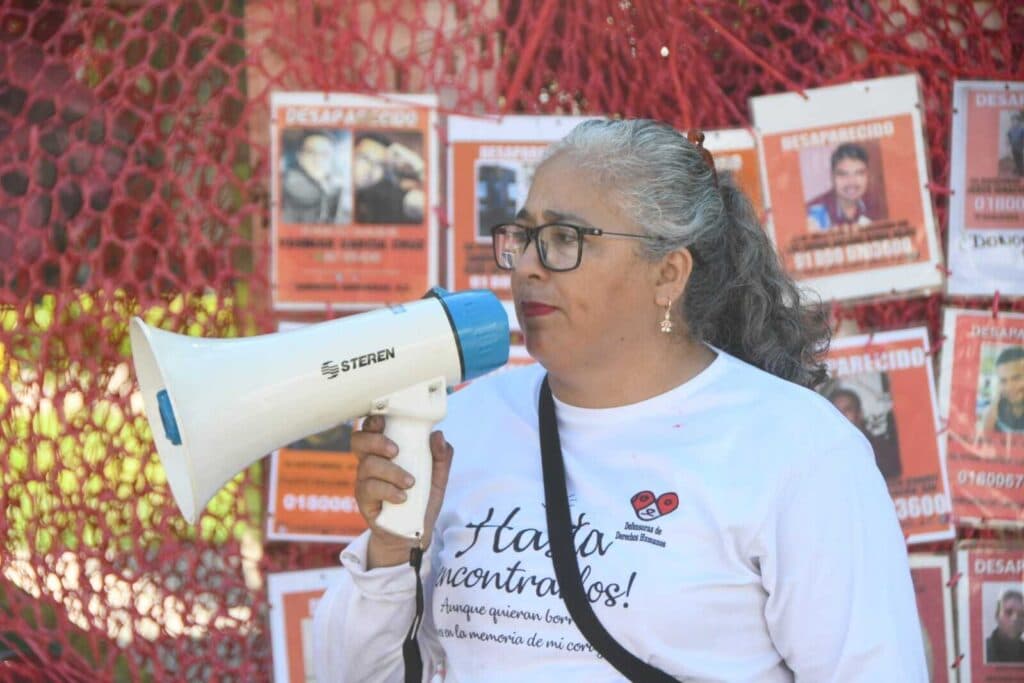
The collective is mostly made up of women searching for missing relatives in Sinaloa. They receive anonymous tips, usually of specific locations, through phone calls or social media, and nearly every week, they head out to search.
In the eight years since the group was founded, they’ve uncovered hundreds of clandestine graves and human remains. “And with all those little pieces, I’m putting Yosimar back together,” Cruz Bernal explained.
On the day of their trip, the women were following a lead about a possible grave on the outskirts of Culiacán — deep inside cartel territory.
Searches like this are dangerous. Sinaloa is in the middle of a long-running drug war. Criminal groups often bury their victims in unmarked graves — and they don’t want anyone digging on their land.
Belinda Aguilar, another member of the collective, said the group had received death threats and were once attacked during a search. “Thankfully, none of us was hurt, but it was scary,” she said.
To stay safe, the group was escorted by a convoy of armed soldiers, one of the only kinds of help afforded them by the authorities.

After the van and the convoy pulled into an abandoned cornfield, Aguilar handed out radios.
It was a scorching morning. The women wore T-shirts printed with the faces of their missing children on them. They grabbed shovels, gloves and soil probes, fanning out across the field.
The ground was dry and uneven. They moved slowly, checking the dirt with metal rods, feeling for soft spots that might suggest something was buried below.
Soon, someone found several bullet casings that appeared to be fired from different weapons. Another woman pointed to what looked like blood at the base of a scorched tree.

They had seen this kind of evidence before. Sometimes it led to a body but other times they were just dead ends.
These women aren’t professional forensic experts — but over the years, they’ve learned to do the work themselves.
“It’s not something we’re proud of,” Aguilar said. “But we do it, because no one else does.”

“To report a disappearance, families often turn to the collectives first, because they don’t trust the government will do anything ” she said. “The system doesn’t work without us.”
There are dozens of search collectives like this across Mexico. Most rely on their own funds. Many members have trained themselves in the basics of forensics, from anthropology and archeology to photography and evidence handling.
Cruz Bernal used to work as a hairdresser. Now, she’s studying criminal law.
By the end of that day, they hadn’t found any remains. So, they marked the site, took photos and left — exhausted, physically and emotionally.
Before they returned to the van, Cruz Bernal called out to the missing: “Muchachos, ¿dónde están?” — “Guys, where are you?”
In 2018, Mexico launched the first national registry of the disappeared. The list now includes nearly 130,000 names, most of them men. Many are believed to have been recruited by organized crime groups — or killed for refusing. Women and girls are often taken too, sometimes for sexual exploitation.
The crisis escalated after 2006, when then-President Felipe Calderón launched a militarized war on drug cartels. Since then, the country has seen an explosion of violence: mass killings, torture, extortion — and disappearances.
“Disappearance can be the cruelest of all,” said Vianey Arce Sandoval, who spent years searching for her missing son. She’s part of the Sabuesos Guerreras collective.
“It’s like an illness — one that slowly consumes you,” she said. “It deprives families of a body to mourn, of answers and the simple certainty of death.”

She eventually found her son’s remains. “And that only brought a different kind of pain,” she said.
She is now seeking justice, though she admits she has little hope. In Mexico, just 16% of criminal investigations were resolved in 2022, according to government data.
Karla Quintana, former head of the National Search Commission, said the government has long lacked the resources to respond.
“We didn’t have enough — and still don’t have enough — anthropologists, archaeologists, criminologists,” she said. “The families were searching on their own.”
Quintana resigned from the group in 2023, after critics accused the government of undercounting disappearances ahead of an election year. She said the system was still in its early stages.
“The foundations of an institution and a public policy have been built,” she wrote in her resignation letter, but acknowledged that much more is needed.
One of the most urgent problems is the backlog of unidentified bodies. An estimated 50,000 are sitting in morgues across the country — with no names attached.
To help address Mexico’s growing forensic crisis, the government has partnered with the United Nations Population Fund (UNFPA) to improve identification processes.
The collaboration, which began last year, is scheduled to run through November.

“We support the implementation of a nationwide fingerprint system to match fingerprints for human identification purposes,” said Maximilian Murck, coordinator of UNFPA’s Human Identification Program in Mexico.
The initiative began by digitizing morgue records and cross-checking them against Mexico’s voter ID database. In some cases, they’ve also used databases from neighboring countries.
“What we’ve seen is that there’s plenty of data in Mexico,” Murck said. “What’s needed now is the capacity to share and match it effectively.”
So far, the project has helped confirm more than 6,500 identities — including one missing migrant matched through a Honduran database. UNFPA has also helped analyze DNA samples abroad, including through partnerships in Germany.
Some local governments are already seeing results. In Zacatecas, a state that has been hit hard by cartel violence in recent years, State Prosecutor Cristian Paul Camacho said his office has adopted the UN tools and protocols.
Camacho acknowledged that, until recently, fingerprinting wasn’t even routine when bodies arrived at morgues.
“Before, many were just placed in refrigeration without being processed,” he said. “There was a lack of planning, resources — and sometimes, willingness.”
Now, his office is comparing fingerprints immediately, while they’re still viable. In the last year alone, his team has identified nearly 300 individuals through fingerprint analysis. Cross-checks with DNA databases have helped confirm more identities.
Still, obstacles remain. Camacho said many forensic teams still lack basic tools to share information across cities — or even within the same state. And Mexico’s largest fingerprint database only includes adults, excluding many missing teenagers and children.

Even so, Camacho said the model backed by the UN is working — and should be expanded. In Zacatecas, he said, “it’s already changing lives.”
UNFPA is now working with officials in other states, including Sinaloa, Tabasco and Quintana Roo.
The agency hopes to extend the program beyond this fall, with the goal of identifying all 50,000 unidentified bodies across the country.
But the scope of the crisis remains daunting as the number of missing keeps growing faster than the number identified.
UNFPA coordinator Murck said the ultimate goal is to help identify all the 50,000 currently unidentified bodies sitting in morgues across Mexico first.
“Identifying the dead is just one part of the mission,” prosecutor Camacho said. “The bigger goal is to prevent more disappearances — and to rebuild trust with the Mexican people.”
Journalist Marcos Vizcarra contributed to this report.
