Public radio’s longest-running daily global news program.
©2026 The World from PRX
PRX is a 501(c)(3) organization recognized by the IRS: #263347402.

The latest Trump administration policies could strip half a million people who came to the US legally of their humanitarian protections. E., a journalist who fled Nicaragua, fears she could also be affected.
In this file photo, a journalist holds up a copy of an independent newspaper in Managua, Nicaragua, Feb. 7, 2020.
As the Trump administration ramps up immigration arrests, flooding the streets of Los Angeles with masked agents, it is simultaneously stripping half a million people of humanitarian protections that allowed them to enter the country legally — essentially turning them into undocumented immigrants and threatening to deport them.
One of those people is a Nicaraguan journalist who escaped a crackdown on the free press in her homeland, and recently landed in the Bay Area in California. The journalist, a woman in her 40s, asked KQED to identify her only by her first initial, E., because she fears what the Nicaraguan government could do to her if she’s deported, or to the family she left behind.
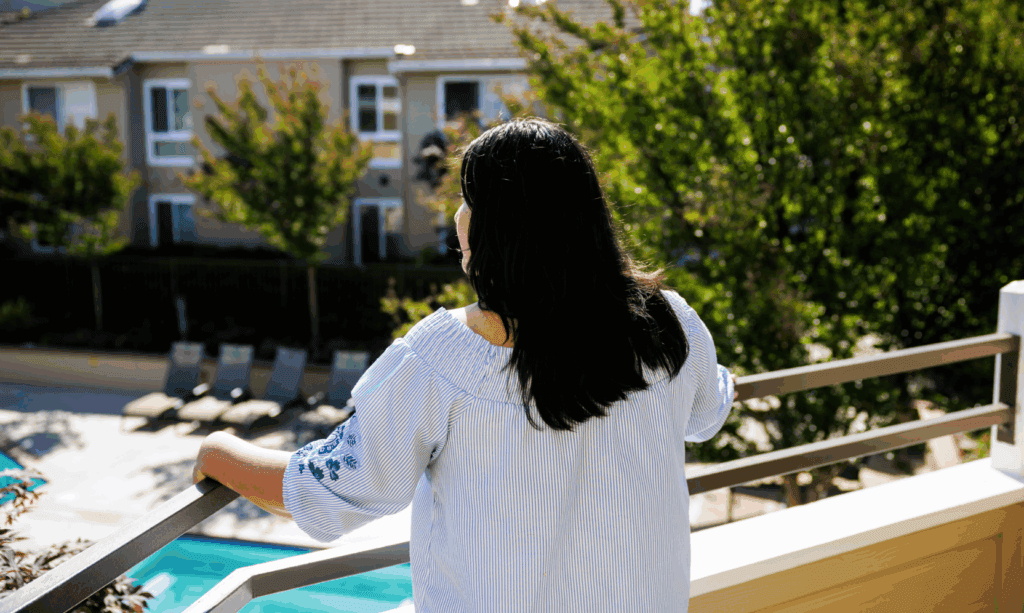
E. recently rented a new apartment in a suburban housing complex in Concord. She told her story as the Trump administration began sending letters out notifying her and more than 530,000 others from four unstable and authoritarian countries — Cuba, Haiti, Nicaragua and Venezuela — that a Biden-era humanitarian parole program under which they had come to the US lawfully, had been terminated.
Thinking back to what brought her to this point, E., who’s a mother of two, described her path to becoming a journalist. She was in high school when she discovered the profession, and she said interviewing politicians and covering the news of the day seemed exciting. She built a career spanning TV, radio and newspapers and, over time, her work took on increasing urgency.
“It gave me the opportunity to give voice to the voiceless and hold power to account — to question what’s permitted under the laws and the constitution,” she said. “Of course, in some countries it can be dangerous to bring to light what’s happening.”
In recent years, Nicaragua has become such a country. The government of President Daniel Ortega has taken control of some news outlets and shut others down entirely, locking up journalists on false charges.
Ortega first came to power as part of the Sandinista leadership that waged a leftist revolution to topple the 43-year Somoza family dictatorship in 1979. He was elected president in 1985, but when he was voted out five years later, he stepped down.
After winning reelection in 2006, though, Ortega tightened his grip on power. A bloody crackdown on protesters in 2018 was followed by a 2021 election in which Ortega jailed most opposition candidates. His party dominates the legislature, and he has progressively gained control of the police, the military, and the courts. He has made his wife, Rosario Murillo, co-president. And in June, a former general who became a critic was assassinated in Costa Rica.
In spite of the risk, E. stayed, even as others left the country. Journalists from formerly competing media outlets teamed up to report clandestinely and publish news without bylines, getting information out about human rights violations however they could.
They learned of an “enemies list” compiled by the regime, and contacted the people whose names were on it, so they could try to escape, she said.
“If you’re on the list, they will get you. The only thing to do is to run,” she said. “I have friends who wanted to stay and face justice. They said, ‘I don’t have anything to fear.’ I told them, ‘No! Go! Get out!’”
Then, in late 2023, E. found out that she was targeted. “My source told me: ‘Run! you’re on the list.’”
E. said she kissed her children goodbye and, with the help of her journalism network, went into hiding. Soon, police began violently questioning her family about her whereabouts.
“I will never regret becoming a journalist,” she said, brushing her long dark hair away from her face. “But my family shouldn’t have to pay. When I decided to be a journalist I didn’t know that this was part of the package.”
Nicaraguan journalists already in exile in Florida helped her find a US sponsor and apply for the parole program, which Biden officials had designed as a way to shift the growing number of migrants from the four countries away from the border and into a lawful, if temporary, pathway.
Eventually, last spring, E.’s parole was approved and she flew to Florida legally — with a two-year work permit and, once on US soil, the chance to seek asylum.
She was one of more than 40 journalists who fled Nicaragua last year, she said, while five colleagues who stayed are now in prison.
When she landed in the US, she said, she touched the earth and thought, “Thank God! This land is welcoming me and I can start over.”
“E.’s case is a great example for why we even had the program,” said Reena Arya, E.’s immigration lawyer with Jewish Family and Community Services of the East Bay. “The United States vetted her, ran her fingerprints. … They stamped her passport.”
In Florida, she found work she loved, doing public relations for nonprofits. And she applied for humanitarian parole for her children.
But the day US President Donald Trump took office, he issued an executive order ending the program, along with other “categorical” parole programs, such as one for Ukrainians who fled the Russian invasion and Afghans who escaped after the Taliban takeover.
After waiting 70 days for her kids’ applications to be approved, E. knew they would instead be void. She said when she found out, she cried the entire day.
Advocates sued the Trump administration to preserve the humanitarian protections, including the so-called CHNV parole for Cubans, Haitians, Nicaraguans and Venezuelans, as well as those for Ukrainians, Afghans and others.
“For more than 70 years, under both Republican and Democratic administrations, humanitarian parole has been a longstanding and effective lynchpin of our immigration system,” said Esther Sung, legal director for Justice Action Center, the pro-immigrant group that brought the suit. “It has been a lifeline for people facing humanitarian crises in their countries of origin and has been one of the last remaining lawful pathways for people to secure temporary protection in the US.”
In April, a federal judge in Massachusetts halted the parole terminations, and an appeals court declined to reverse that decision. But in late May, the Supreme Court ruled the government can start revoking parole while the case, Svitlana Doe v. Noem, plays out in court. The next hearing was set for July 29.
Sung called the revocations unprecedented, and added that she considers them part of a plan by the Trump administration “to de-legalize people here lawfully to advance its anti-immigrant agenda.”
In a statement on June 12, Homeland Security spokeswoman Tricia McLaughlin called the CHNV parole “disastrous,” saying the Biden administration had poorly vetted parolees and suggesting those admitted were responsible for “chaos” and crime.
“Ending the CHNV parole programs, as well as the paroles of those who exploited it, will be a necessary return to common-sense policies, a return to public safety, and a return to America First,” McLaughlin said.
A different observer, award-winning Venezuelan journalist Boris Muñoz, who’s a former New York Times editor and UC Berkeley journalism lecturer, has seen the impact of the parole — and its termination — up close.
Muñoz came to the US on a fellowship, but as then-President Hugo Chavez consolidated power in Venezuela, Muñoz decided it wasn’t safe to go back. He has since become a US citizen, and he’s watched over the years as other Venezuelan journalists flee the growing repression in their country.
The CHNV parole offered them a legal way to get here. And the crackdown on press freedom in all four countries covered by the program is well documented.
“In particular, for journalists, it’s crucial,” Muñoz said, “because they cannot live in their countries.”
But he added that the journalists who arrived with parole are now in limbo, as their work permits are canceled and the possibility of deportation looms.
“I think it’s a cruel measure that’s not addressing the promise Trump made to clean the country of criminals,” he said. “These people are not criminals.”
Leaving her office in Florida one afternoon in February, in the early weeks of the Trump presidency, E. said she saw US Immigration and Customs Enforcement (ICE) agents rounding up immigrants on a nearby avenue and loading them onto buses.
She had thought that with the protection of parole, she had nothing to fear from ICE. Now, she realized that she could be next. E. felt hunted again, as she had in Nicaragua.
“I thought, ‘I can’t stay here,’ and I called some friends in California,” she said.
They told her they thought she’d be safer if she joined them, because California’s sanctuary laws prevent local police from helping ICE with immigration enforcement.
So, E. uprooted once more, arriving in the Bay Area with nothing. She said she slept on friends’ couches until she found the apartment in Concord. And she landed a supermarket job to pay the bills while she looked for work in her field.
But she recently received the DHS letter canceling her parole and her work permit.
The prospect of deportation is terrifying, she said, fighting back tears, because she expects she would be imprisoned, as others have been.
“If you ask me if I fear going back to my country, the answer is ‘yes,’” she said. “I’ve never been scared in my life. I’ve always been strong and brave. But I’ve seen what they’re capable of. I’ve seen people who were tortured, who were held in deplorable conditions. I don’t want to suffer. I don’t want my children to suffer.”
With her immigration lawyer Arya’s help, E. applied for asylum, so, if normal rules apply, it’s unlikely she’ll be deported anytime soon. But Arya said the revocation of parole means the promise of protection has been broken.
“It’s fundamentally unfair,” she said. “It’s not how our immigration system has ever worked. And we’re entering a new era where the government thinks they can do that. And it’s a very scary door to open and walk through.”
For now, E. has plans to furnish the apartment. She should eventually get a work permit through her asylum application. And if she wins the asylum case, as Arya thinks she will, E. will eventually be allowed to bring her children here, though that could be years away.
And she wants to work for a just society, she said, whether for Nicaragua or in the US.
“I want to help,” she said. “That’s what I’ve always done. And one day, I will be doing it again.”
This story first appeared on KQED on June 30, 2025.