PRX is a 501(c)(3) organization recognized by the IRS: #263347402.
US and Syrian officials visit each other’s countries as Damascus finds footing on global stage
The World’s Host Carolyn Beeler speaks with Rep. Marlin Stutzman (R-IN) about his recent trip to Syria, the first visit by US lawmakers since the ouster of former Syrian President Bashar al-Assad in December.
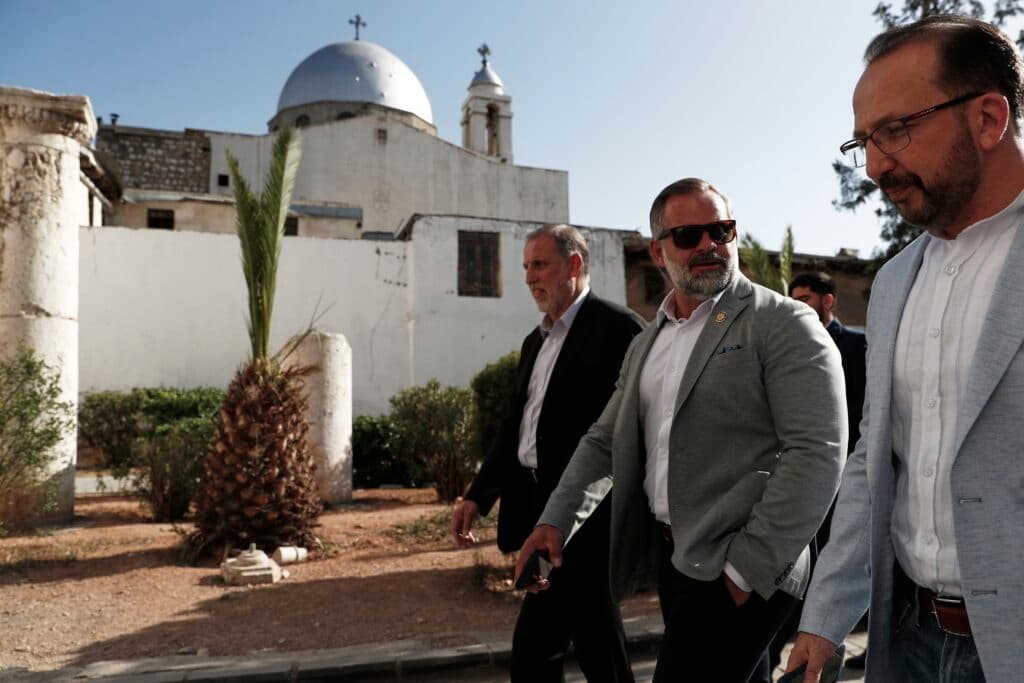
US congressmen Cory Mills (R-FL), left, and Martin Stutzman (R-IN), second from right, meet Mor Ignatius Aphrem II, a Syrian-American Christian prelate serving as the Patriarch of the Syriac Orthodox Church in Damascus, April 18, 2025.
Omar Sanadiki/AP
Syria’s new foreign minister, Asaad al-Shibani, was in New York last week to raise the country’s flag at the United Nations. Syria’s government is looking to forge ties with international institutions and the United States.
Syria’s Foreign Minister Asaad Al-Shibani holds the Syrian Flag during a ceremony where the Syrian flag was added to the 100 flags flying in line at United Nations Headquarters, April 25, 2025.Kena Betancur/AP
Earlier this month, Rep. Marlin Stutzman (R-IN) was one of two congressmen to visit Syria. He toured Syria’s capital, Damascus, and met with Syrians on the ground to discuss their needs during the country’s political transition.
It was the first visit by US lawmakers since the ouster of former Syrian President Bashar al-Assad in December.
Accompanied by unidentified members of the delegation, US congressman Cory Mills (R-FL), second from right, walks in the Old City of Damascus, April 18, 2025.Omar Sanadiki/AP
Host Carolyn Beeler spoke with with Rep. Stutzman about his visit, his meeting with the new Syrian President Ahmad al-Sharaa and what the US’ priorities for Syria should be in the coming period.
Carolyn Beeler: What exactly were you looking to accomplish with this visit?
Congressman Marlin Stutzman: I felt that this was an opportunity to help, not only the Syrian people, but also to be a voice and eyes and ears for the American government. Obviously, al-Sharaa has a very dubious past, as a former al-Qaeda member. And so, we’re all very skeptical. I was very skeptical of him and wanted to see for myself, is this a cause that I could support on the international stage and the community that, of course, the Syrian community that’s very concerned about the direction Syria is going to go. And so, having that opportunity to, not only see the people, to see the prison where Assad tortured and killed so many people, but also to eventually meet with President al-Sharaa.
So, as you’ve said, you met with the new president, Ahmad al-Sharaa. And as you mentioned, this is someone who was part of a group that is designated as a terrorist organization by the US government. What did you talk about and what did you come away thinking about him and his goals for the country after that conversation?
I think his goals for the country were very positive. His goals for the region were positive. And the fact that he was reaching out to the West and that he wanted to talk to the American government. I asked him directly if he had spoken with President [Donald] Trump. He said that he hadn’t, but his people were talking to President Trump’s people, talked about what his vision was for the country and for the people of Syria. He wants to keep the country together. His biggest concern was that it might be divided up. He talked about commerce and trade and trade lines, tourism, that would be for the country, talked about the infrastructure of the country, how it’s so depleted. The sanctions are obviously a big piece that they would want to see lifted by the United States in order to rebuild.
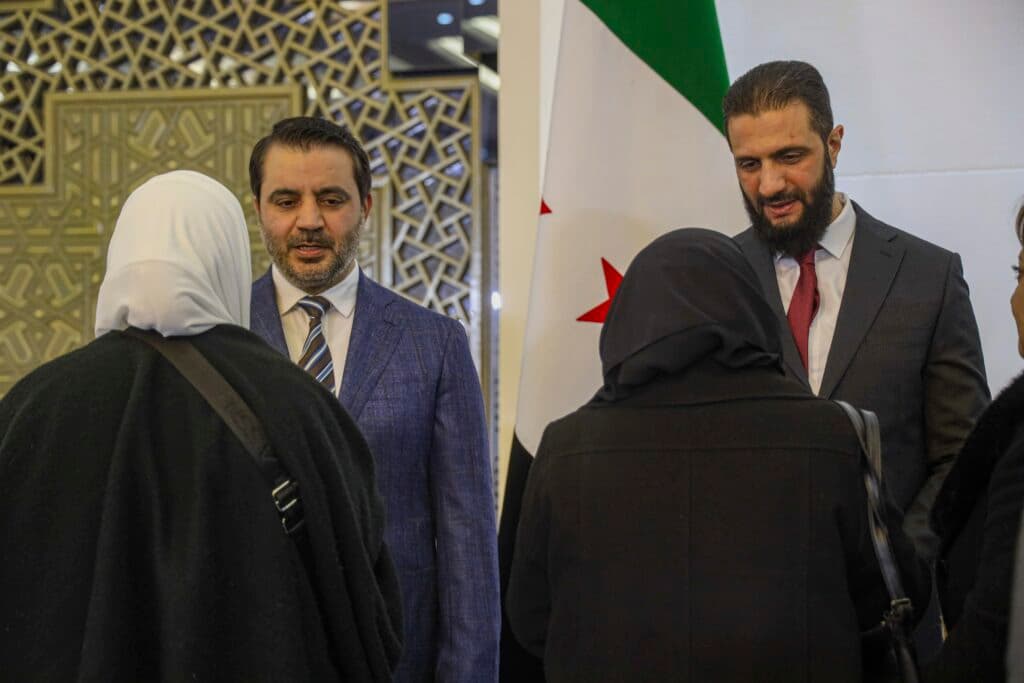
Syria’s interim president, Ahmad al-Sharaa, right, and interim foreign minister, Asaad al-Shibani, greet delegates during Syria’s national dialogue conference at the People’s Palace in Damascus, Syria, Feb. 25, 2025.Omar Albam/AP/File photo
So, you do sound quite positive after your meetings with al-Sharaa and other members of his government. The US has not officially recognized that government, nor has it lifted sanctions on Syria. After your visit, what would your advice be on those two matters regarding US policy toward Syria?
We should be engaging with the new government, talking with President al-Sharaa. He has had offers from the Russians. He has the Chinese reaching out to him. One of the things that he mentioned to me, because I told him that the relationship between America and Israel is very strong, and what was his vision on the relationship between Syria and Israel? And several things that he mentioned were he didn’t want to see Syria divided into different sections, and also he wanted to address what he called encroachment around the Golan Heights and also some of the bombings there. But he suggested that he would be open to the Abraham Accords with negotiations.
That’s normalizing relations with Israel.
Yeah, that’s right. And so, I just think that we have to have a dialogue.
You mentioned that Israel has been encroaching on Syrian territory. It’s been bombing Syria. Was there a question of whether the US would do anything to pressure its closest ally in the region to reduce these attacks?
There’s nothing that I’m aware of, and I think that President al-Sharaa knows he is weak right now. He knows that he doesn’t have a strong military. He’s trying to pull the militias together. He’s really just trying to unify inside the country. And I think that’s a positive sign. But I don’t completely blame Israel either for making sure this is an opportunity to guard their back door as well.
You know, there’s a concern that Turkey would get any closer to Israel. They don’t want to see a proxy state from Iran or Russia or China, any sort of terrorist activity. So Israel is, I believe, doing the right thing by making sure that whatever the turnout is, whatever the final result is over the next several years, that Israel is protected.
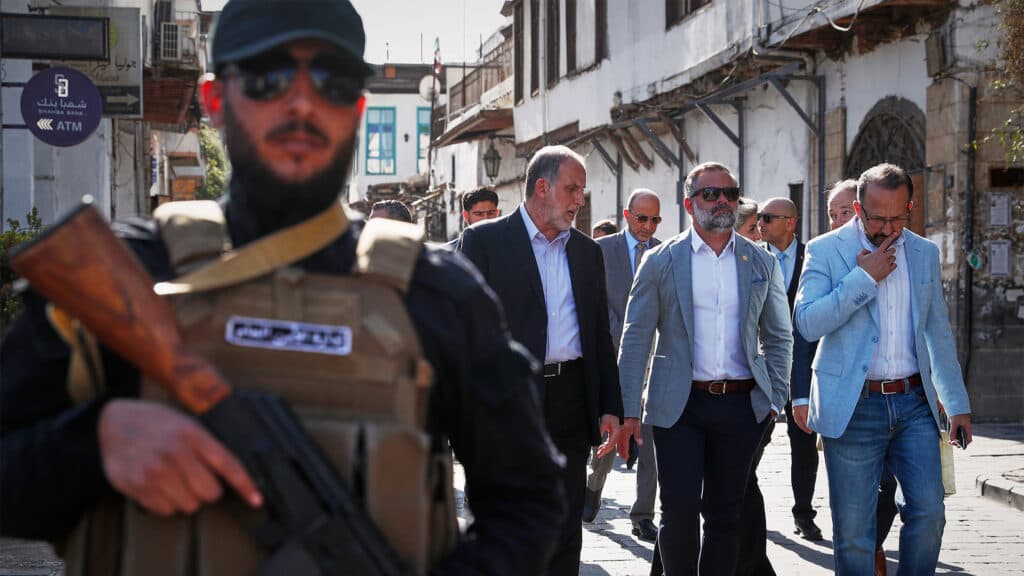
Accompanied by unidentified members of the delegation, U.S. congressman Cory Mills (R-FL), second from right, walks in the Old City of Damascus, April 18, 2025.Omar Sanadiki/AP
You visited over Easter, and I understand that you visited with local Christian communities during your visit. What did they say to you about Syria’s transition?
You know what, they were very hopeful and they were anxious to show Congressman Mills and [me] that there were mosques and churches across the street from each other and that people were worshiping in harmony and in peace and they are hopeful again that President al-Sharaa is going to bring a new Syria, a new peace and new prosperity to the country. They’re open to that. You can tell that they are so happy that Assad is gone.
I mean, this wasn’t a racial genocide. This wasn’t a religious genocide. This was a political genocide by the Assad regime. And the fact that he bombed Jobar, which was just billions of dollars of destruction of a community just outside of Damascus that was just utterly destroyed, just shows you that he had no regard for any person if they disagreed with him as the leader of the country.
Congressman, I want to follow up on one thing you said a moment ago, which is you said that you thought Israel was doing the right thing and trying to protect itself here. It is, though, seizing territory inside of Syria, not just protecting its own borders. Do you think that is really essential to protecting Israel’s safety?
I do. The northern border has always been a dangerous point for Israel. So, I completely understand why Prime Minister [Benjamin] Netanyahu decided to take that position because we don’t know what the result is going to be in Syria. But you know what, if there’s a good relationship between Syria and Israel, that shouldn’t be a point of contention.
This interview has been lightly edited and condensed for clarity.